“The 2023 Burgundy vintage delivered an abundance of approachable, fruity red wines as well as lush, round whites for early drinking.”
“If one characteristic defines the 2023 vintage in Burgundy, it’s abundance. For Pinot Noir, this was a year of abundant yields; for Chardonnay, 2023 is a year of abundant flesh…”
“Best year since 2015 in the Côte de Beaune, with ripe, focused black fruit flavors, fine structure and freshness.”
“The early view that whites might stand above the reds in 2023 was justified because Chardonnay performs better than Pinot Noir at higher yields.”
“Overall, 2023 Burgundy is an engaging vintage for white wines, which are ripe, supple, juicy, and medium-full. Over the course of ten days in early September, the aromatics and fruit flavors evolved from citrus, through white peach and golden, to tropical.”
“Expect delicious and juicy white wines, without evident dilution, but probably not destined for the very long haul… By the time I finished the tasting program, I had become more enthusiastic–in some cellars, this clearly really is a great vintage.”
“The 2023 Burgundy whites are not unlike the 2022s, but with a little less acidity, depth, and structure … Alternatively, they are somewhat like 2017, with more alcohol and body but less acidity
… The wines that feel sweet on the finish remind me of 2019, but with less acidity and less concentration.”
my limited take
2023 Burgundy surprises me. Throughout the region, from Chablis down through to Beaujolais, this bumper crop of balanced fruit delivered a much-needed cellar restock in time for the tiny quantity produced in 2024, where losses across much of Burgundy were catastrophic. For growers like David Duband, who lost around 90% of their 2024 crop, the generosity of 2023 isn’t just a gift; it stands as a bridge over the collapse of his next vintage to the seemingly strong medium-sized crop in 2025.
After tasting the 2025s out of barrel in several cellars in December, I’m optimistic about them. It continues the winning streak of the ‘5s, where ‘85, ‘95, ‘05, ‘15, and now 2025 delivered some seriously good wines.
According to Burgundy journalists, Chardonnay and other white Côte d’Or varieties are the most consistent across the greater region in 2023, showing freshness, precision, and a faithful expression of terroir. After ten days in Burgundy in December, this aligns with my experience so far in the Côte d’Or and throughout many regions in France, even outside of Burgundy. The 2023 whites are easy to drink, and even if lower average acidity is a criticism, the overall balance is good. The acidity matches the elegant and subtly complex profile, and I’ve often found a recurring nuance, contrasting sweet green and very subtle gold fruit and herbal notes.
The warming trend continues to pull today’s wines further away from the past—away from that combination of natural core density, internal snap, and the measured austerity of cooler eras. Still, some producers manage remarkably well. I continue to enjoy Côte d’Or whites and Chablis from certain growers (even in warm years), but many, particularly of the former, fall short of the promise implied by their prices, while Chablis remains a bargain. Chardonnay in the greater Burgundy area remains compelling and complex, but more often now new releases feel like an aging iconic musician settled into a long Vegas residency; the taste and complexity are still there, just not the same charge.
Nowadays, when I peruse a list rich in Côte d’Or wines, there are too many average growers at exceptionally high prices. I get it, the appellations command certain prices, and no grower is going to be the one who’s not cashing in on that. But I ask myself, who are the suckers who still throw hundreds down on average wines that don’t deliver on the promise of price and pedigreed appellation? Once wine crosses a certain price threshold, ho-hum won’t pass muster. No single ounce of wine should really cost $25, so a $25 sip of a $400 bottle better be absolutely mind-blowing.
The disconnect between price and performance has widened to the point where expectation outpaces delivery, often leaving even committed Burgundy drinkers unsure of what, exactly, they’re paying for anymore. Many top-shelf Côte d’Or wines seem to be graded—and accepted as though—on a curve within the context of their season and recent vintages. They’re more skinny-fat, underdeveloped versions of the core compaction of the not-too-distant past. What once felt like wines built from the ground up with tension, depth, and a kind of internal discipline are recognizable but often underwhelm. Prices are simply too high now for most wine lovers with modest budgets, and I wonder how many of the smaller growers even justify drinking their own wines these days when they can get so much for them. (Don’t get high on your own supply!) I stopped drinking most of my cellared wines and have begun to sell them because, even if I paid twenty or thirty bucks two decades ago and they’re now worth hundreds, I still don’t like to drink beyond my daily budget. I’ve always had an overpowering bargain shopper in me, and I don’t like, as I often say, “to drink money.”
Price is one of the many reasons why I appreciate our two main Côte d’Or growers. Rodolphe Demougeot and David Duband both perform at a high level with great value compared to other top domaines. They scratch my itch without breaking the skin.
2023 was also a wonderful surprise in many of the white wine-producing appellations in northern Europe. Even the hot 2022 delivered, seemingly propped up in many regions by the reserves rebuilt through the cold and rainy previous season. I admit that I have an easier time with warmer Burgundy years with Chardonnay than Pinot Noir: the knife’s edge that Pinot Noir teeters on is often too unforgiving in overall profile, for me. If the fruit is even just a little overripe and the flowers lightly wilted, it’s so contrary to what compels me to drink Pinot Noir-based wines that it’s hard to power through a bottle. A lack of vibrant tension of fruit and the lift of flower strongly present in its youth is, to me, a misfire. Red wines from the world’s greatest terroirs often have floral elements not only present but often in the forefront when they’re young, and continue to pleasantly haunt decades after their birth. When the flower fades, my passion for the wine fades with it.
Where high yields often signal dilution, the 2023s I’ve had so far have held their shape remarkably well, showing sound concentration, brighter fruit and better fluidity at this moment than 2022, along with better integrated tannins. In some ways, the vintage for reds seem to echo 1999, another high-volume year with extremely solid quality that a few reviewers initially overlooked due to the perception that the high yield would dilute the wines too much, yet I don’t think the same mistake is being made with the critics in 2023. Grading on the curve, perhaps? Not entirely. The stuffing’s mostly there, but who really knows if the season will yield a mass of vin de garde, yet balance is known to carry wines well beyond expectation. Yields are a useful reference point, but not a predictor of quality. The conditions of the year, the reserves from the previous year (maybe 2021 didn’t only prop up 2022 but also 2023!), and the strength of each vine matter more than a tidy hectoliters-per-hectare figure. When decisions are made plant by plant, rather than by tractor passes or uniform vineyard recipes, generous crops can still produce balanced, age-worthy wines, and this is where the divide becomes clear: growers who work in their own vineyards will make those micro adjustments rather than run the same play no matter what the vines show them. David’s wines are so reliable now from one year to the next, it’s apparent that he’s adapting (even if he gives the same generic answer each season when asked about whole cluster percentage, new wood, etc.). For growers like David, that adjustment appears in subtle ways rather than dramatic stylistic swings from season to season.
2023: what duband’s wines say
Across both colors, the wines show a straightforward and proportionate sense of alcohol, acidity, fruit, and tannin, all falling into place without any forced adjustments. This is not a vintage that presses its claim to greatness; it offers the early pleasure of wines already speaking in complete sentences, yet likely with enough guts to reward those in search of the complexities developed years down the road. And while many regions benefit from newfound consistency in the fully ripe flavors where they once occurred only every four years, Burgundy is facing a harrowing climate change dilemma—it’s particularly existential (at least for the new generation) in the prime historical spots. Aside from the challenge of frost and hail almost every year, the solar beatdown on what makes it to harvest day is, on average, may be off balance if one uses the past as the measure. But somehow, 2023 is a little different. (So is 2025.) Those high yields, which were often seen as harbingers of diminished quality to come, work well in warmer years to buffer concentration and alcohol with slow ripening. This is apparent in David’s 2023 range.
While the bandwidth of David’s wines is intentionally narrower than that of other growers, I love the idea of near radically different but similarly compelling wines from the same grower working the same ground each year. The intuitive part is to allow the voice of the season to shine brightly early, or remain quiet but with a smile, or even turn inward if that’s where they’re going for a period, revealing itself in its own time. A closer look at David’s gentle craftwork reveals his true artistic symbiosis with nature’s path: to do little more than place his signature where it can’t be ignored.
2023 was a hot year that followed another hot year that came after a frigid and wet year. Although it has a very different profile than 2017, a year that started with a cooler growing season, then went nuclear in the summer (the inverse of 2025), 2022 and 2023 are surprisingly resilient and fresh given the extreme heat. While 2022 theoretically had more water reserves after the 2021 rains, 2023 probably didn’t have as much. But somehow, like many red wines across continental Europe, Duband’s and Demougeot’s ‘23 reds seem finer than the 2022s: equally more open but more reddish, lifted and ethereal. The 2023s from Duband have a similar, slightly roasted bright Nebbiolo-like red and orange fruit and flower component that shows a little more like 2019 without the slightly roasted notes. 2023 was indeed hot and plentiful, but so were many years that produced fabulous wines. Duband’s range is full of generous wines with enough nuance to remind you of the breed of this region, even in the face of difficult weather for such a sensitive bunch of grapes.
duband cellar quickie
Stems are included in all Duband red wines (average: 30–40% for Hautes-Côtes and Bourgogne, 70–80% for Village/1er Cru, 80–100% for Grand Cru). Fermentation is assisted with a pied de cuve developed from the first batches of grapes harvested. Pigeage (punchdowns) is done by foot to avoid breaking stems and begins after fermentation starts, with 5 to 7 total over the full 17–18-day maceration period. Remontage (pump overs) is used only when reductive elements appear, which is more common in organic wines. After pressing, the wines settle in tanks for 2–3 weeks to allow whole-cluster ferments to clarify more fully (destemmed ferments clarify more quickly). The wines are racked for the first time before the end of the year and moved to barrel (20–25% new oak for Hautes-Côtes and Bourgogne, 25–30% for Village and Premier Cru, 30–40% for Grand Cru—all a
little lower than in recent years). Since the 2022 vintage, sulfites are added for the first time only in December and January after malolactic fermentation, and a small 7 mg/L dose was added at crush. No filtration or fining.
hautes-côtes
David’s style of Chardonnay resonates with us. They’re clear, clean, free of technique, toying to push up reductive elements to get the wines to zoom in more on minerally impressions than fruit. They are direct and classic wines, and will resonate with historical Burgundy drinkers and even the California palate. His chardonnay hautes-côtes de nuits comes from 40-year-old vines (2024) in the Hautes-Côtes de Nuits, planted on medium-steep slopes with a southwest exposition on limestone bedrock and clay topsoil.
Surely the absolute best deal in Duband’s price-sensitive range is the coteaux bourguignons rouge. It’s a total darling. So easy to drink. So pure Pinot fruit. So pure Burgundy without any pretense.
After having it in the cellar this December, I went home to open the single bottle I had at my house. It was just like the tastes we shared with David at the cellar, only a full bottle to see if it veered off course, which it didn’t even after a few days of observation. Too good, in fact. The only challenge with this kind of wine for those of us who enjoy a long night of slow wine appreciation is how easily it can go down. It comes from 30-year-old vines (2024), planted to 90% Pinot Noir and 10% Gamay, on a northeast exposition on limestone bedrock and clay topsoil.
In 2023, the aromatic appeal of the hautes-côtes de nuits ‘louis auguste’ is more pure and elevated earlier on than in any other year I remember. In many years past, it had to jump the hurdle of reduction, but this year, that’s nowhere to be found in the nose for more than a short moment.
Perhaps this is the most upfront and elegant version of this wine I’ve had since the 2008 vintage we first imported. It comes from parcels in Chevannes, planted in 1995 on very steep slopes with south and southwest exposition, at 335–455 meters, on limestone bedrock and shallow, rocky clay topsoil.
côte de nuits | north to south
Now we’ll take a tour of the côte, starting in the north and working our way south. The appellation classifications will vary, but it will better serve the identity of each wine and the changes in elevation and exposition along the côte rather than focusing on classification as the guide.
The wines that are often overlooked but rarely underdeliver are the côtes de nuits-villages that come from Brochon; think Denis Bachelet. A substantial wine with a rare label is this Côte de Nuits-Village planted in 1995 entirely in Brochon (the sliver of land between Gevrey-Chambertin and Fixin) on gentle slopes with east and southeast expositions at 220–250 meters on limestone bedrock and shallow clay topsoil.
A commune of many faces, Duband’s gevrey-chambertin comes mostly from the area most known to produce elegant wines: again, Brochon—think Denis Bachelet’s and Jean-Marie Fourrier’s Vieilles Vignes wines, and this will give you an understanding of the quality of this area inside the commune. Because of the dominance of fruit from Brochon, this wine is notably more lifted and elegant than the typical Gevrey-Chambertin appellation wine. Duband’s parcels come from Les Journaux, Les Gueulepines, Les Croisettes, Pince-Vin, as well as a small dose at the southern end, Les Seuvrées (a village lieu-dit just below Mazoyères/Charmes Grand Cru and on the border of Morey-Saint-Denis) and nearby Reniard. The vines were planted in the 1970s on gentle slopes with east and southeast expositions at ~250 meters on limestone bedrock and red/brown clay topsoil.
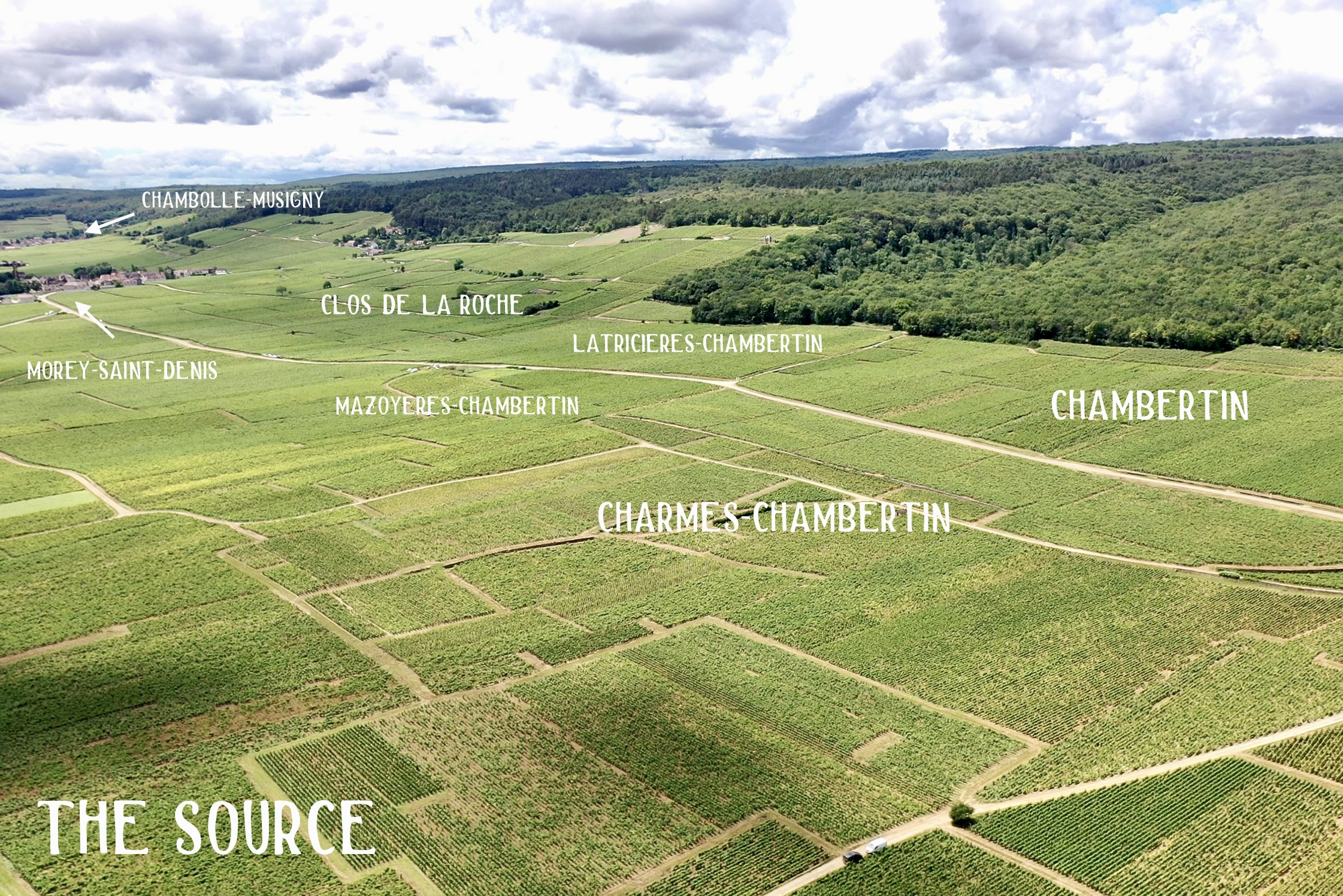
There isn’t a more profound wine in Duband’s range than his chambertin. Going north to south leads to his top grand cru before all other grand crus are explained. And while it seems that occasionally one grand cru in the range could squeeze in there and oust it, I’ve never had that experience in fifteen years of tasting the range at his cellar. Even within a one-ounce taste after working through the range, it always stands alone, not only in profundity but in style. His whole range is lifted, and while this is too, it’s a hammer when it strikes the palate, exploding, expanding, and resting on it like an emperor on his throne. Long known to perform its best in warmer years compared to cooler ones because of its slightly flatter surface, and the cooling Combe de Grisard, Chambertin’s Siamese twin to the north and outside of the combe, Clos de Bèze, can sometimes perform a little better in the cooler ones. Chambertin may have the edge between the two with today’s climate change. David has two parcels of about 60 years old that add up to 0.22 hectares: one up high at around 300-310 meters, and another one that runs from the top of the slope to the bottom, dead center at 280-300 meters, both on limestone bedrock and shallow (20–25 cm) red and white clay topsoil. Yes, it’s pricey, but unlike many grand cru experiences, this won’t leave you wondering why it’s considered to be one of the greatest vineyards in the world.
How to follow Chambertin … Perhaps the wine to do it inside of David’s range is the latricières-chambertin, Chambertin’s southern bookend, his parcel located approximately thirty vine rows south of the Chambertin border. This has long been one of David’s rarest and hardest-to-get grand crus. It’s more charming with more upfront fruit and elegance than Chambertin, but not as galactic in breadth. We got our first minuscule allocation around the 2016 vintage and would take every bottle offered. It’s the wine in the range I know the least (due to price and scarcity), but each year I’ve had a taste at the cellar just before Chambertin finishes the flight. It’s sometimes easy to forget once Chambertin has colonized every bit of surface area in the glass, wiping away the memory of almost all that came before it. But if it were the last wine tasted, it could still take the throne and resonate even more. It comes from vines that were 65 years old as of 2023, on a gentle slope just inside the Combe Grisard with an east exposition at 280–300 meters on limestone bedrock and shallow (10–20 cm), rocky brown clay topsoil.
While perhaps more compact and reserved than other charmers from this grand cru, the old vines in David’s charmes-chambertin, planted in the 1920s at 270-280 meters on shallow (10-20 cm) rocky brown and red clay topsoil, give the wine tremendous depth, and historically it has been a slow reveal. That dynamic is beginning to shift. A small but meaningful replanting in 2016 has introduced younger vines into the blend, bringing a new immediacy and aromatic lift that wasn’t always present in recent vintages. Even so, with an average vine age still quite old, this remains one of the most physically imposing wines in the range—built for distance, not for speed. The parcels lie in Mazoyères-Chambertin, a climat labeled as Charmes-Chambertin, though the distinction matters. (Wines made from the Charmes-Chambertin climat cannot be called Mazoyères.) The imprint on wines from Mazoyères differs from most Charmes: cooler air, deeper and rockier soils, and a longer line of tension, thanks to its position in the path of the Combe Grisard, which formed the terrain in the past and now dictates to some degree the air currents and temperature. This wine has behemoth tendencies, often backward in its youth, but the sun also rises here without obstruction now. With it comes a renewed sense of charm, perhaps at only a modest cost to extreme long-term aging; it’s a wine that carries its strength calmly and without bravado.
Few other wines than clos de la roche represent my strongest emotional center in the Côte d’Or. Perhaps others follow—Clos Saint-Jacques, Ruchottes-Chambertin, Musigny. One could posit that our entire portfolio’s red wine style is based on the general character of the wines from these specific vineyards: high tension, expansive, a slight tilt toward bone rather than flesh, a solid opening, a slow but intense burn, and always a forcefully dynamic second half. In my earlier years, I could afford to splurge on a bottle here and there—an expense shared with friends, of course. In fact, a bottle of 1985 Dujac represented a turning point in my wine life—a decisive pivot toward Burgundy. Like his Echezeaux parcel, David has great fortune with the position of his Clos de la Roche. It comes from the center of the cru, in the original Clos de la Roche lieu-dit, before the later expansions. The vines, planted in 1960, grow on a gentle to medium slope with an east exposition at 285–295 meters, rooted in hard limestone bedrock with shallow (10–20 cm), rocky brown clay topsoil. Like his 1er Cru Clos Sorbè, the equilibrium of this wine—on a slightly bonier frame for a grand cru, reminiscent of Ruchottes-Chambertin—is of the highest order, where restraint, depth, and authority endure. David’s rendition of Clos de la Roche springs quickly from the glass, but it asks restraint in return; only with patience does its full measure reveal itself. Like most great wines, this should be shared between two people, three at most. Any more than that, and the full wingspan and depth of this beauty are cut too short.
Perhaps the wines that carry the deepest emotional value with me are those from his morey-saint-denis holdings. All are wonderful, charming, beautifully choreographed, and capture the “completeness” of this fabulously tiny commune stacked with as much talent in the cellar as any other on the côte. As I write about this collection of vineyards from north to south, I know well where my preferences unintentionally land. Like his Nuits-Saint-Georges village wine, this wine is often overlooked but delivers on all fronts. It’s hard to pick a favorite among his village appellation wines because all deliver beyond at least what’s expected, and three rise well above the expectation. While the Gevrey-Chambertin’s defining characteristic is that it primarily comes from the area that produces the most elegant wines in the commune, perhaps it’s the solid patchwork of many different parcels from different spots in the commune that make this MSD so well rounded: Les Porroux (bordering Chambolle-Musigny below 1er Cru La Bussières; planted in the 1980s), Clos des Ormes (bordering the 1er Cru of the same name; planted 1970–1980), Aux Cheseaux (planted 2011), Les Cognées (planted in the 1950s), and Les Brâs (east of RN74), on gentle slopes with mostly east expositions at 220–230 meters on limestone bedrock and clay topsoil.
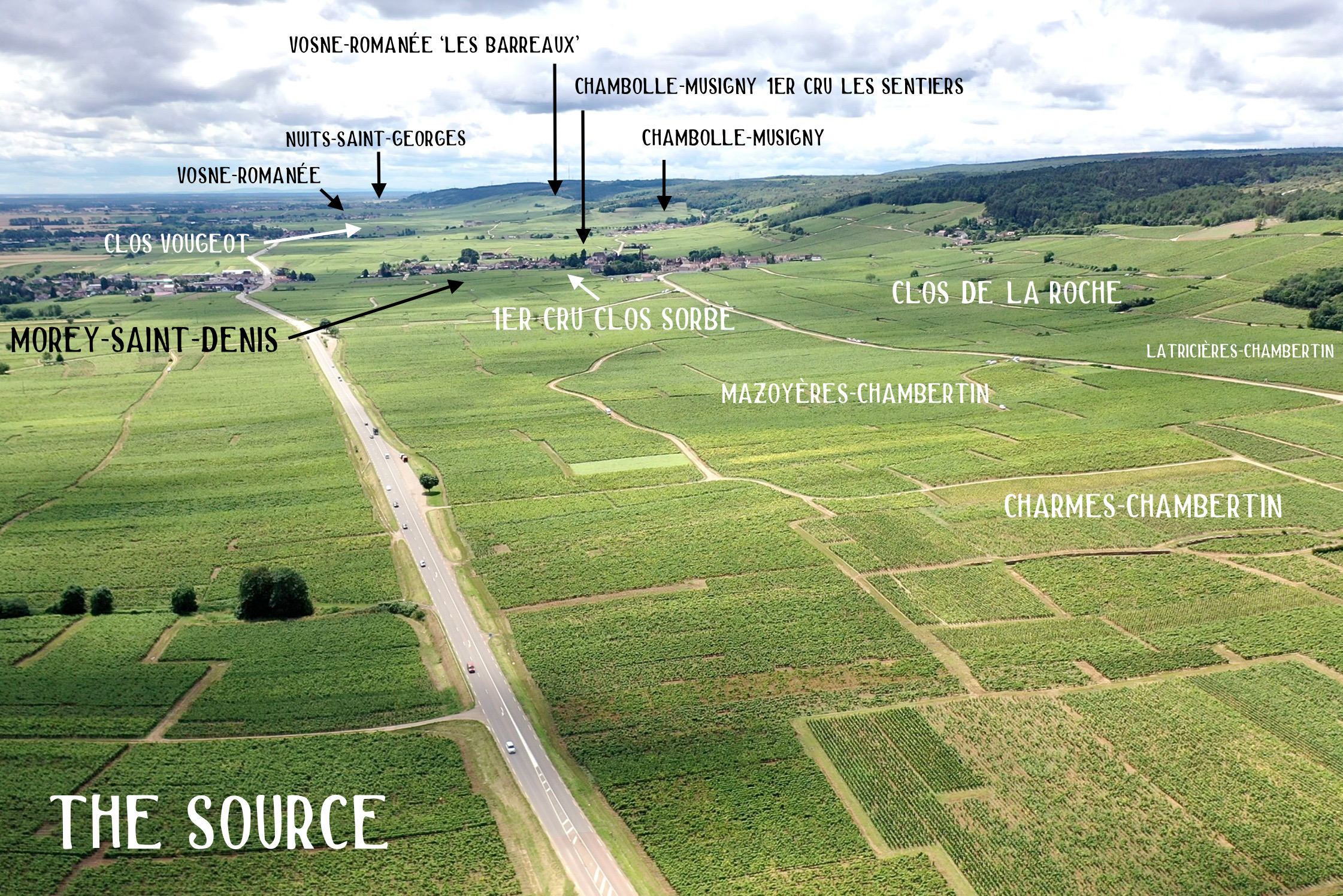
There has only been one other premier cru for me that rivals the morey-saint-denis 1er cru clos sorbè within David’s range of premier crus, and, sadly, that’s no longer part of the range: Les Gruenchers. For this taster, this wine is the full embodiment of Duband’s work from across the entire côte, taking a chapter from all classifications, from Coteaux Bourguignons to Clos de la Roche and Chambertin. Nothing here strikes in an extreme tone of high or low; it’s a wine of resolute balance, containment, intellectual currency and class. It comes from vines planted between the 1950s and 1990s on a gentle slope with an east exposition at 260 meters on limestone bedrock and shallow red/orange clay and rocky topsoil. In my mind, this, along with Clos de la Roche, is the heart of David’s production.
Similar to his village appellation, the morey-saint-denis 1er cru les broc comes from a collection of micro-parcel top vineyards, only this time all premier crus, so it’s a serious upping of the ante. While Clos Sorbè is more individual due to its parcel singularity, the mix of superstar premier crus that go into Les BROC sit around it and below the grand cru slope; they are Blanchards, Rouchots, Ormes, and Chezeaux, and they forge a robust wine with a little more stuffing and breadth, with the average vine age of 55 years. Another grower in the appellation, Virgile Lignier put it succinctly: the slopes here are gentle but deceiving in position. In the middle of this row of premier crus between the village and Gevrey-Chambertin, a reverse fault uplifted some bedrock below, creating a shallower topsoil bed than what one would expect. This shallower soil on gentle, east-southeast-facing slopes reads, in body, a little finer like a higher-altitude premier cru than one at this altitude, but with a slightly riper and fuller fruit profile. So many special wines come from this premier cru section of this commune, and this, even if it’s a blend of four, isn’t one to miss—a unique singularity of this strip of the Côte d’Or comes through.
David’s bourgogne rouge has always been a reliable profile that, like the Coteaux Bourguignon, delivers on immediate appeal and doesn’t let up for days. It mostly comes from vines in Morey-Saint-Denis and Chambolle-Musigny, balanced with tension brought from a touch of his Hautes-Côtes de Nuits parcel. The vines were planted between the 1960s and 1990s on gentle to steep slopes with east, south, and west expositions at an altitude of 250–450 meters on limestone bedrock and clay topsoil.
Like David’s Vosne-Romanée that delivers on all levels expected from this “pearl of the côte,” his chambolle-musigny appellation wine delivers on the promise known for finesse and restrained power. It’s primarily sourced from Les Chardannes and Les Herbues (below a series of top premier crus and beneath Bonnes Mares) from vines planted in the 1970s on gentle slopes with a southeast exposition at 250 meters on limestone bedrock and clay topsoil.
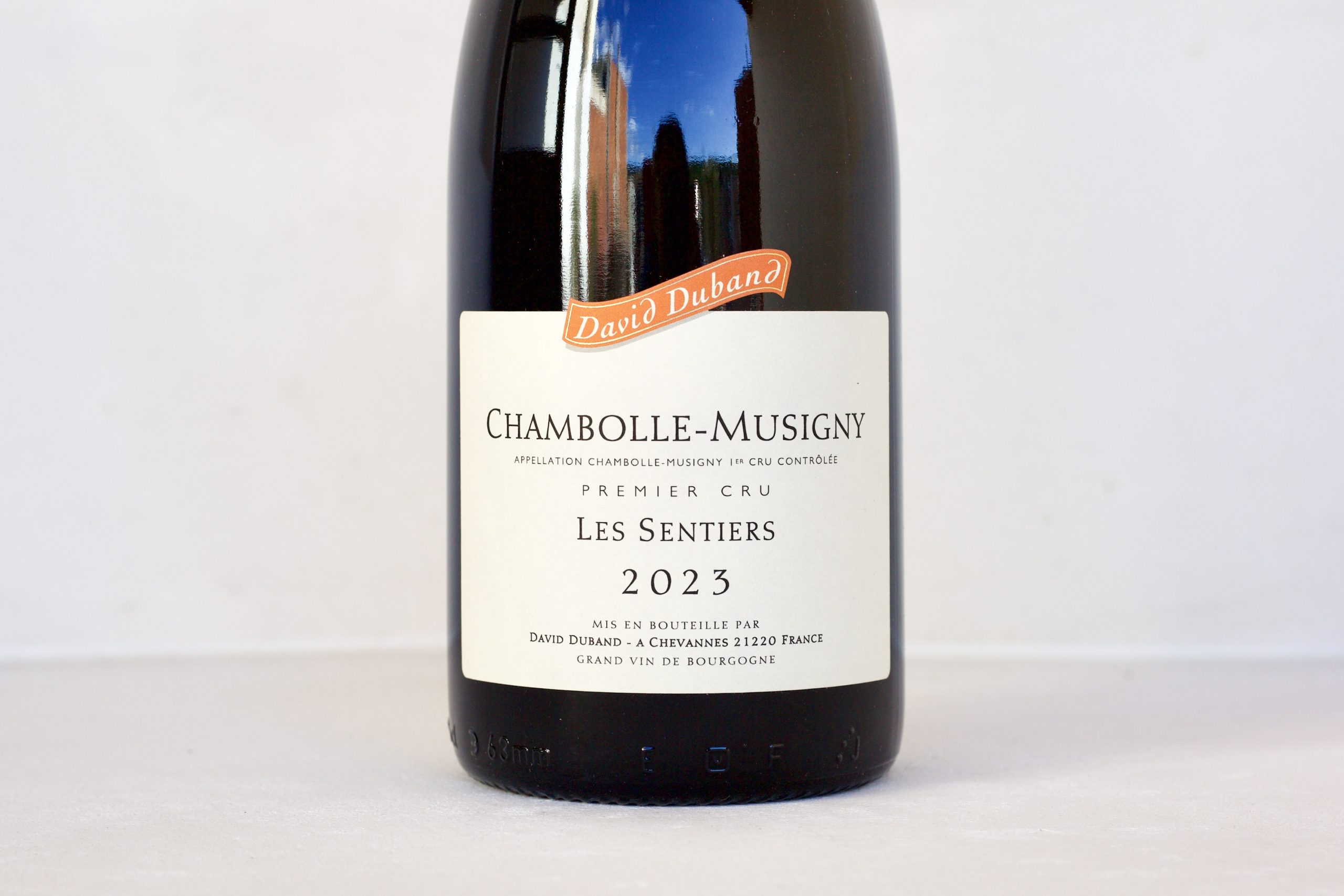
Located on the north border of the appellation, next to Morey-Saint-Denis 1er Cru Les Ruchots, and just below Bonnes Mares and above “Les Bussières,” the chambolle-musigny 1er cru les sentiers is a stouter wine than others inside this commune, further from Morey-Saint-Denis; this has to be taken into account that David’s wines are indeed always on the more elegant side despite the appellation. It comes from vines planted in the 1960s–1970s on a gentle slope with a southeast exposition at 250 meters on limestone bedrock and heavy red clay topsoil.
On April 1st, 2016, I accompanied Raj and Jordan during their vineyard tour with David for their book “Sommelier’s Atlas of Taste.” It was drizzling and freezing, and David brought us down into the muddy and flat clos vougeot where Raj and Jordan almost got their car stuck. I’ll never forget sitting with David in his 4X4, giggling as they slid and spun the wheels of their ill-equipped rental like they were on ice. That’s David’s Clos Vougeot: a 60-year-old plot in the center, relatively flat, 245 meters altitude, and deep brown clay topsoil. It works well in hot years, but in rainy years, it’s not ideal. With a slightly darker robe of red compared to much of the range, this powerful wine still charms with its typically smooth, velvety texture anchored in grand cru poise.
In Burgundy, it’s all location, location, location, then craft. In expansive grand crus like echezeaux, location is paramount to understanding the potential quality and how the wine may present itself independent of the grower’s hand. David is a lucky one; much of this grand cru is greatly influenced by the Combe d’Orveaux on the north side and La Combe de Concoeur on the south side. His parcel sits right between these two combes but high enough up on the hill to place it in a more classical strata that many of the great grand crus have. It’s the lieu-dit Les Rouges du Bas, higher on the slope and from vines planted in the 1930s at 280–300 meters (the upper end of the sweet spot;
e.g. La Tache runs about 250-290m; Musigny 280-300m; Clos de Tart 270-300m; Clos de la Roche 270-310) on limestone bedrock and shallow, rocky red clay topsoil. I’ve always found this to be one of his most underrated, over-deliverers one could buy in the grand cru world: 100-year-old vines, prime position away from the combes, same altitude as some of the greats, and in Vosne-Romanée? That should pique interest.
With the first sip of David’s vosne-romanée, one can only throw up their hands and say, “Well, that’s Vosne-Romanée for ya …” followed by a battle for restraint from pounding this charming, even voluptuous—by Duband standards—Vosne. It comes from 90% Les Barreaux, planted at an altitude of 300-340 in the 1950s on a medium-steep slope next to/north of Les Petits Monts, above Richebourg and Cros Parantoux (not a shabby hood) at 300–340 meters, tipping just inside the combe. The remaining 10% comes from Aux Ormes, planted in 1990 on a gentle slope east of the village center at 235 meters. While that 10% of Aux Ormes brings this Romanée rocket ship a little closer to earth, it’s hard to compete with the pedigree of this fabulous “village” wine, especially in the face of climate change. With vines running south to north instead of the typical west to east, the upper position of Les Barreaux tips to the north with an eastern tilt into the windy combe, facing off with Beaux Monts. This should offer more relief from today’s blistering sun compared to many other parcels in the commune. What was once a potential liability is now an asset.
It’s hard for any appellation wine to follow a Vosne-Romanée. And this is what drives growers like Duband to vigilantly pursue the key to unlock nuits-saint-georges and its long-standing typecasting as a hard Burgundy with too much austere texture. A continuation of Vosne-Romanée to the south, the north end of Nuits-Saint-Georges naturally shares kinship with the wines made next door. But probably like many Burgundy pilgrims, I’ve long blistered past both hills of Nuits-Saint-Georges on my way to somewhere else on the côte—in the car and on wine lists. I can’t do that anymore. NSG has begun to heat up and shine for me. Perhaps it’s climate change. Maybe there’s been a commune-wide stylistic makeover? Or I might simply love minerally wines (obviously). Few red wine appellations express mineral and metal textures as clearly as Nuits-Saint-Georges, and now that their tableside manners have improved, they’re far more accessible. Now, if you blend roughly 20% Les Plateaux (planted in the 1950s) from the north end of the mineral and metal-heavy south hill with the Vosne side’s natural charm via 80% La Charmotte (planted 1960–2000) and Aux Saints-Juliens (planted in the 1950s) on the north hill, just downhill from the premier cru Aux Thorey, you may begin to understand Duband’s Nuits-Saint-Georges. Anyone who gives it a fair shake quickly realizes that he has, in fact, unlocked this appellation while not overplaying it. More soprano than baritone, more starlet than stalwart, it’s not a supporting role but a quiet lead inside a strong cast.
I’ve tasted in David’s cellar every year for the last fifteen years, and every time I conclude that people should know this wine: a fresh and cool mineral-armored but refined texture and the right amount of fruit to charm without betraying its roots. It’s not what you might expect, unless you’ve had it before: a triumphant parry to any preconceived notion of what it “should be,” because it’s far better.
Toward the tail end of Nuits-Saint-Georges’ north hill, Duband’s nuits-saint-georges 1er cru aux thorey comes from vines planted between 1950 and 1980 on a gentle, medium-steep slope with a southeast exposition on shallow, rocky, orange clay topsoil. This is a transition wine with similar but more restrained generosity of the Vosne-Romanée side, with a textural profile that only whispers its connection to the south hill—think a slightly more Ironman build than NFL running back. Aux Thorey has always been solid from David, and in way, a Côte de Nuits wine that uniquely carries orange fruit and flower notes, refined minerally textures, rusty iron, and a refinement that one may see as a common thread to a young but already secondary orange-infused Giacosa Barbaresco or Le Ragnaie Brunello while still obviously Côte d’Or Burgundy. Of all in the range, Aux Thorey and its brothers on the NSG south hill, Les Pruliers and Les Procès, not only thrive with food, they’re made for it.
The neighboring plots, Nuits-Saint-Georges 1er Cru les pruliers and 1er cru les procès are on the north end of the premier cru line on the south hill—the hill best known for its ferrous-inflicted wines. In a line of three, one could say that well-dressed beast of the range, Les Pruliers, is a firstborn filled with expectations and strength, Aux Thorey the middle, the quieter intellectual, the listener, finer lines, and the third, Les Procès, a little bit of both but naturally closer to Les Pruliers. Pruliers and Procès from vines with an average age of about 60 years on a gentle slope with a southeast exposition. The difference, as explained by David, is that Les Pruliers receives a little more sun than its brother, who’s tilted slightly toward the north. Les Pruliers also has deeper topsoil, making Les Procès a little more minerally with a touch less muscle—indeed, right in between these NSG premier crus.
Les Terres de Philéandre
notes by ted vance
Monsieur Duband has a newish project (started in 2018), a portmanteau created from the names of his twins, Philomène and Léandre: Les Terres de Philéandre. While he’s best known for his meticulous stewardship of some of the Côte de Nuits’ most prestigious appellations, this deeply personal project was born from a desire to work with greater freedom at the margins of Burgundy’s formal hierarchy—to step back into something quieter, more intuitive, and perhaps even more revealing. With only a few parcels in Savigny-lès-Beaune, the grapes for this project are primarily sourced from the Hautes-Côtes de Nuits, just adjacent to his classified vineyards, and are often labeled as Vin de France (VDF). These wines draw from medium-aged to old vines rooted in clay-limestone soils and shaped by the same rigor that defines his domaine work, with whole-cluster fermentations, native yeasts, gentle extraction, long élevage, with sulfites added only after malolactic fermentation—or not at all where the wine allows. Les Terres de Philéandre doesn’t sit apart from Duband’s core work; it quietly completes it.
Les Terres de Philéandre fills a continually widening gap on shelves and lists for years: Burgundy that smells, tastes, and seems like what it is, priced fairly, without feeling diluted or like the result of a quiet cellar declassification. The Hautes-Côtes areas just to the west of Côte de Nuits and the Côte de Beaune share the same basic geology, and they will matter even more as the landscape continues to shift due to climate change. Like many wines from the Hautes-Côtes, these wines feel like a preview of what’s coming. Once again, we’re able to drink “value” Burgundy that doesn’t ask us to lower our expectations.
Both TdP 2023 whites strike a higher chord than one might assume, considering their appellation classifications. Both come from vines in the Hautes-Côtes de Nuits, just adjacent to HCdN parcels with the VDF Chardonnay “Le Blanc” from 30-year-old vines that reads nearly as much like an Aligoté as a Chardonnay; the Côteaux Bourguignons Chardonnay tastes like Chardonnay. It comes from 40–60-year-old vines, both facing southeast on steep clay and limestone slopes. I know–you’ll have to taste ‘em to believe it. You’re right, and you’ll see what I mean when you do. It’s rock-solid, with no extra trim, no tinkering, just clear and focused white Burgundy.
Hautes-Côtes de Nuits vineyard where many of Duband’s wines come from
Unlike the two Chardonnay-based TdP wines grown in old French Burgundy barrels, the Bourgogne Aligoté was aged in a combination of 30% concrete egg, 30% in a 25 hl Stockinger foudre and 40% in steel to build texture without masking its natural tension. These grapes come from 50-year-old vines in the Hautes-Côtes de Nuits, facing southwest on steep clay and limestone slopes.
The 20-year-old (2026), high-altitude vines for the VDF Pinot Noir on steep, east-facing slopes just next to Duband’s HCdN vines underwent whole-cluster maceration for 10 days, with one daily pumpover during the first four to five days, followed by foot pigeage three times per day over the final five days to release maximum sugar before pressing. The wine was aged for ten months in 228-liter French oak barrels ranging from one to five years old. Sulfites are added after malolactic fermentation, and there’s no fining or filtration.
I admit it: we made a mistake with Célénie. I’ve always had reservations about ordering no-added-sulfites wines, even from top technicians. Indeed, we have quite a few wines like this now, but we scrutinized them all heavily before buying. Yet here we are with this Hautes-Côtes de Nuits Rouge ‘Célénie’ as one fabulous example of a sans soufre wine gone completely right, and we’re in very short supply—only until we get more. After getting a little bored with the classical Burgundy profile of fruit that is often even a little tired compared to some of the regions we work in, when I poured the first taste for my wife (who doesn’t drink much anymore), she looked at me like I’d asked her to marry me again and said, “Now this is my style of wine.” Then, when I tasted it at the cellar in December with our San Francisco boss, Marissa, her first reaction was excitement, and then regret: she didn’t request any when I placed our first order for the 2023s because she, like everyone else, wanted to taste them before jumping on the Duband Sans Soufre Soul Train. Three wines into our 25-wine tasting, we pleaded, David scrambled, and now we’ll have a few more cases on the water destined for the warehouse in March or April. These grapes, harvested from 50-year-old vines in the steeply sloped Hautes-Côtes de Nuits, underwent whole-cluster maceration for 10 days. There was one daily pumpover during the first four to five days, followed by foot punchdowns three times a day over the last five days to release maximum sugar before pressing, then aged in a Stockinger foudre. No added sulfites, no fining, and no filtration. This is yet another testament to sans soufre wines’ success when left to those who have mastered the fundamentals first. Congrats to David and to his son, Louis-Auguste, who surely spurred his dad into doing this experiment. What a wine!
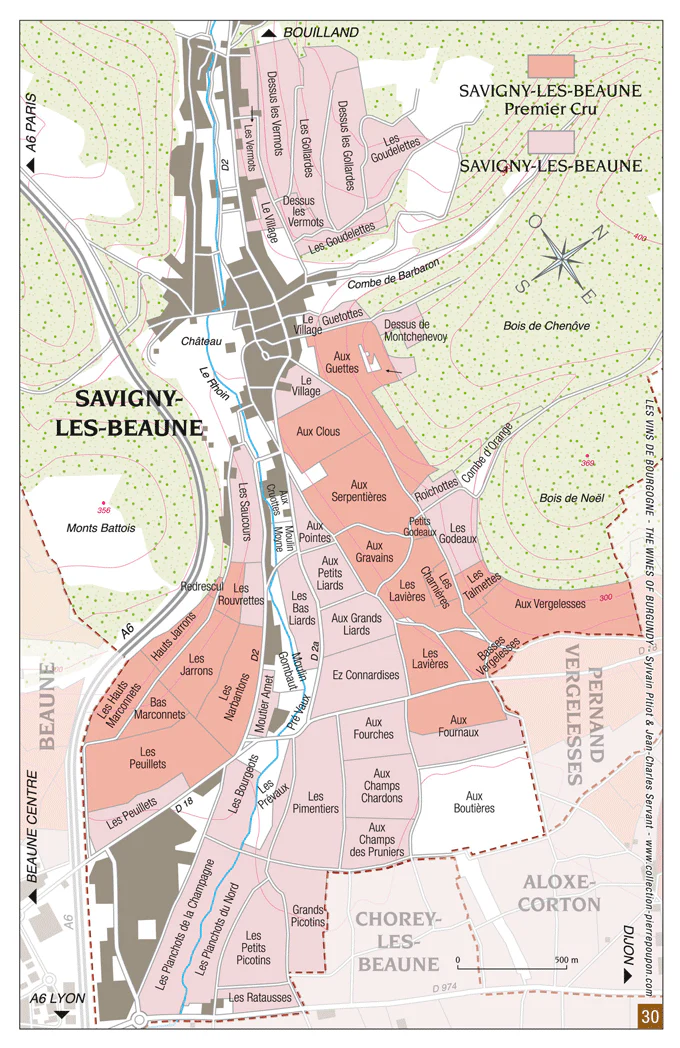
We’ve had a lot of interaction with Savigny-lès-Beaune over the years; early on, we imported Simon Bize, Jean-Marc et Hugue Pavelot, and Bruno Clair, and it’s nice to have some wines from this underrated place. David has a few different ones, but we went with his appellation Savigny-lès-Beaune Rouge and the 1er Cru Aux Serpentières both from 50-year-old vines (2026) and vinified the same way in the cellar: 70% whole clusters and macerated for 10 days, with one daily pumpover during the first four to five days, followed by foot pigeage three times per day over the final five days before pressing. It ages for 13 months, in 40% new oak 228-liter French barrels, with the first sulfites added after malolactic fermentation, and no fining or filtration.