

Hajszan Neumann

This website contains no AI-generated text or images.
All writing and photography are original works by Ted Vance.
Related material
Short Summary
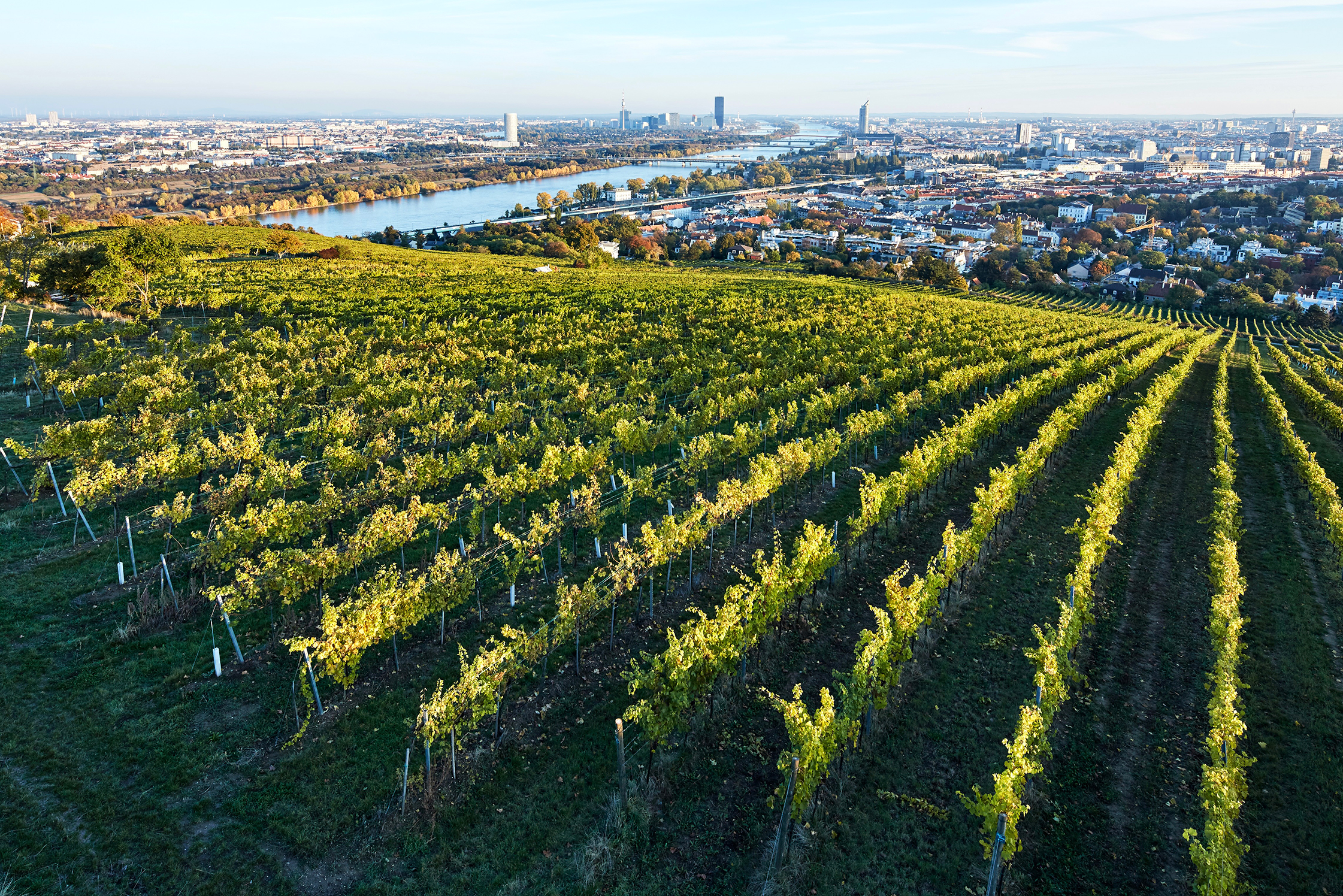
Long before Vienna became a bustling eastern European capital city, it was covered by a sea. Today the Hajszan Neumann vineyards are rooted in what that sea, the winds and the Danube left behind: limestone hills, Flysch sandstone, marl, quartz veins, marine sediments, loess and river sediments shaped over millions of years. It's from this unique hillside terroir on the Nussberg, shaped by forest air and the cool water and airstream of the Danube, that long-time biodynamic grower and master wine crafter Fritz Wieninger—known for his eponymous classically styled winery—created his more free-thinking Hajszan Neumann project, named after the previous owners. Here he draws a clear line between two ranges: traditional wines quickly pressed and raised in steel and large oak barrels, and natural wines fermented on the skins with extended maceration and aging in amphora or concrete egg with no sulfur added—artistic yet a compelling argument for no-added-sulfite wines from skilled winegrowers.Full Length Story

With the rise of organic and biodynamic viticulture over the last half century and their becoming commonplace throughout the world in wine-focused restaurants and wine shops, the forever controversial natural wine movement was as inevitable as it was necessary. Like its viticultural forbears, and despite its ingrained provocation of many 20th-century traditionalist winegrower views, the emergence of natural wine continues to drive a broader recalibration across winegrowing at every level. Ideologically, it’s coherent. Theoretically, it’s feasible. Practically, it remains impossible as a pure state. There is no vine cultivated and no wine made without decisive intervention, no matter how restrained the intent. Yet, the concept of natural wine remains, and perhaps it also remains the ultimate ideal: organic 3.0; biodynamic 2.0.
Extraordinary results can indeed emerge in natural wine, but rare cosmic harmony alone is not enough to build a consistent body of quality work. Nor is it enough for an importer shipping wine across the Atlantic, even in refrigerated containers, to bet hard-earned dollars on the system. Enter a long-time biodynamist and master wine crafter with extremely sound fundamentals (at minimum), and we’re going somewhere. While in their later years, artists like Picasso painted pieces that to the untrained eye may appear at best to have been rendered by a talented child with a fully loaded Crayola box, yet a visit to the Picasso Museum in Paris, or the Museu Picasso in Barcelona, or a dig into his work, reveals a master draftsman long before adventuring into abstract imagery. This is Fritz Wieninger’s sidestep from his eponymous winery with classically styled wines into the more free-thinking of his Hajszan Neumann. But with Fritz’s ingrained Germanic formality and architectural mind released into a modern version of 19th-century Parisian bohemianism: precision, brilliance, texture, freedom.
Fritz’s classic Grüner Veltliner and Riesling, grown within Vienna’s city limits, mostly on calcareous soils, is a breath of fresh Austrian air for these varieties from typically more acidic and spare soils of metamorphic and igneous rocks and sometimes calcareous loess in regions further west, like Kremstal, Kamptal and Wachau. The thrilling textures rendered from the Nussberg are nearly singular inside Austria, yet equally noble—perhaps a shock on first taste, as it was for me. His “natural wines,” artistic yet led by fine craftsmanship (the missing ingredient in many wines categorized as such), add another compelling argument for more “natural wines” from skilled winegrowers. Yet, Fritz’s range of natural wines goes far beyond circus tricks. While bohemian in spirit, they are exact in execution, even as he removes the usual safeguards of sulfur, filtration, and fining, and tests his own limits.
Image courtesy of Fritz Wieninger
First Contact
When I first moved to Europe some years ago, my former business partner (and still a great, lifelong friend), Donny Sullivan, told me we needed to start working with these Hajszan Neumann wines, which at the time were brought in by a former import supplier of ours. His enthusiasm pushed us to start working with them before I even tasted them. One order later, they’d already parted ways with the other importer, and, because I lived in Portugal at the time, I never got around to tasting the wines.
Fast forward four years, and Alf Wimmer, Weininger’s Export Manager, Assistant Winemaker and Wine Director for their Michelin Three-Star restaurant, Amador, was relentlessly in pursuit of trying to restart with us. The last thing I needed, I thought, was a bunch of warm-Pannonian-climate Rieslings and Grüner Veltliners to contend with alongside the full collection of all organically certified growers we work with in Austria from colder areas. They were a long-time organic and biodynamic grower, and in such a small Austrian wine world, I had to give them a shot at the very least. I was in Austria for only a few days and had just a few hours to spare. I told him the best I could do was ask Michael Malat if I could taste the wines with Alf at Malat’s winery.
Alf put six wines on the table. I requested the Grüner Veltliner “Natural” orange wine first, the one with the killer label. My staff was begging for orange wines, and if that didn’t pass the test, I could walk away from this one because I had plenty of Grüner Veltliner and Riesling. Upon first taste, I didn’t flinch, but my inner smile slowly spread. Price? Availability? My smile now spread from ear to ear. What, that’s it? What’s the catch? How much do you have? I knew I was already in this fisherman’s net, and he knew it too.
The Grüner Veltliner “Natural” is an incredible no-brainer wine. You don’t even have to like wine to like this wine. But if you like wine, and you don’t like orange wines or natural wines, you will appreciate it. It’s gorgeously crafted and not only an “orange wine.” This is real wine, made by a classicist master craftsman who decided to walk the tightrope of no-added-sulfite natural wine, and it appears to be in an all-out sprint across the wire in full balance and control. This was just the start.
After the orange wine, what ensued was another masterclass—this time more classically styled, with technical winegrowing under biodynamic and organic practices, and at great prices! Everything tasted was dialed and undervalued for its price. The texture of the Grüner Veltliners and Rieslings grown from the combination of Vienna’s relatively young—by geological standards—and ancient limestone bedrocks on the north edge of the city is something you may not find anywhere else in Austria that grows Riesling and Grüner Veltliner. Often, limestone terroirs make very powerful wines. While these have thrust, some compaction in their core, and a fuller contact and a lasting finish across the entire palate compared to many wines grown on acidic soil types, they’re also so lifted, ethereal, super fine, salty, minerally, and addictively textured with a perfect mouthfeel with some chalkiness balanced with salivating freshness and citrus and early-season stone fruits. I’ve had my Austrian wine head only open to the cooler-climate Riesling territories (yeah, Grüners too) west of Wagram that I never bothered to explore east of yet another limestone terroir, Traisental. In the face of climate change, I didn’t want to because I also have to think about the future and our investment with the long view always a guide. Well, I guess my ignorance paid off on this one. They’ve got me well beyond hook, line, and sinker; at this point, they’ve also pulled the rod, reel, and the fisherman overboard. And to understand why these wines are what they are, you have to understand the city they come from.
Vienna Vines
One of the city’s unique features is that Vienna remains one of the rare capitals in the world where vineyards are produced within the city limits. The Romans first planted vines here along the Danube frontier, and monasteries expanded the vineyards through the Middle Ages. But it was the culture of the Heurigen that gave Vienna its true wine soul when Emperor Joseph II allowed growers to sell their own wines directly to the public in the late 18th century. Even as the city expanded and phylloxera tore through Europe’s vineyards in the 19th century, many of Vienna’s hillsides survived and were replanted rather than abandoned or swallowed by the city’s expansion. Today, vines still run through places like Grinzing, Nussberg, and Bisamberg, where limestone, forest air, and the cool water and airstream of the Danube shape wines inside the city lines.

Image courtesy of Fritz Wieninger
Fritz estimates that in Vienna there are about a hundred growers who produce a little wine and sell it at their own restaurant or wine tavern, known locally as Heuriger or Buschenschank. But only around twelve are wineries with serious bottlings, and only about half of those are of professional size. Vienna itself has only about 700 hectares of vineyards but nearly three million inhabitants.
Backstory: Hajszan to Neumann to Wieninger
Like so many stories swallowed by time and war in the former Austro-Hungarian empire, Hajszan Neumann has had several lives before finding its way to Fritz Wieninger—today one of Austria’s most ambidextrous winemakers, equally at home in classical and natural-style biodynamic wines. A restaurant in a spa area built outside Vienna in 1795, the sulfur springs stopped functioning when the Danube River was regulated in the 1870s, and the business eventually closed. In the late 19th century, the property became a sparkling wine production site, but that operation closed during the Great Depression. In more recent history, the building served as a youth center until around 1990, after which it stood empty again.
Stefan Hajszan renovated the building in the early 2000s with the plan for half of it to become a winery and the other half a restaurant. A well-known architect in the Vienna region, Heinz Neumann, was brought in to finance the project. As is often the case with partnerships, the working relationship eventually became too difficult. Stefan Hajszan told Fritz that he could not continue and was willing to let go of the whole operation, suggesting he take it on with the restaurant, the winery, and the 20 hectares of biodynamically farmed vineyards on the table, that he was the right person for the job. Fritz discussed it with his wife, and the next day they began making the deal. Without the right hand and mind, the house of Hajszan Neumann may have remained empty, devoid of activity and inspiration.
Today, it is full of life with a thriving biodynamic winery and a Michelin Three-Star restaurant, Amador. Located inside the city limits, less than one kilometer from the right bank of the Danube as it enters Vienna, are the start of the vineyards on the Nussberg—a Flysch system hill (its name is thought to be drawn from “flowing ground”): deep marine sedimentary sequence of layered calcareous marine sandstone, marl and clay than harder limestones of other famous wine regions—that starts around 200 meters in altitude and rising to almost 400.
The Wieninger Line
When Fritz was a boy, he helped his parents in the vineyards, and as soon as he was tall enough to reach the clutch of the tractor, he was already working with machines in the vineyards. At fourteen, he began winemaking school and loved experimenting with fermentation. Fascinated by the process, he collected cherries and plums, made juice from them, fermented them in glass jars, and even made rice wine. He studied enology at the technical college for wine and fruit growing in Klosterneuburg, near Vienna, then graduated with a degree in enology engineering—the same school his mother graduated from in 1963 as one of the first women to do so. He was in the class of 1985, and his son Maximilian graduated in 2026.
When Fritz first took over Hajszan Neumann, he didn’t change anything. Though the estate’s previous clients liked it as it was, he began to change the style after a few years and created two lines we have today. The first stayed on the classic line with a lighter, straightforward style and more acidity. The second was a return to his childhood fermentation fantasies: a full immersion into natural wine. In his mind, this “natural wine” line should be free to think differently, to rediscover wines similar to those of centuries ago, with more experimentation and from lesser-known varieties. The stylistic difference between the neighboring Hajszan Neumann and his eponymous Wieninger wine project is essential. Without that variation, he would see no reason to keep them separate.
Fritz distinguishes clearly between the traditional Hajszan Neumann wines and the natural wine line, explaining that the traditional wines are grown on limestone with layers of alpine rock on the right bank of the Danube, which gives them liveliness and minerality. With biodynamic farming, grapes can reach full maturity with lower sugar levels. Alongside those wines, the natural wines ferment on the skins with extended maceration of up to five months, followed by aging in amphora or concrete egg, where oxygen plays a strong role, especially since no sulfur is added in the natural wine range. He describes the natural range as having deep, multilayered fruit, with wild notes and mature tannins. He insists, “these wines smell but do not stink, and don’t suffer from volatile acidity or other off-putting notes common in many no-added-sulfite wines.” And while Fritz admits that they don’t express terroir as strongly as the traditional wines, they are full of character and uniqueness.
Changes of Weather
Climatically, Vienna is a bit warmer than the regions to the north and west and also receives a bit more rain. It’s somewhat cooler than the east and the south. Far to the south in Styria, it is cooler again because of the higher elevation and almost double the rainfall of Vienna. Vienna itself is set at the very last rolling hills of the Alps. The hillsides are often planted with vines, with the residential areas further down. Above the vineyards, there are forests, and as one moves away from Vienna, the hills rise more and more toward the west. There are no vineyards directly west of Vienna; the wine regions there are to the northwest, like Kamptal or Wachau.
Climate change has had a major effect on Vienna over the last twenty to forty years. Fritz explained that harvest now comes roughly four weeks earlier than what he remembers from his childhood—not necessarily every single year, but more and more often. Young vines now need irrigation, or too many are lost—a practice also seen in southern France, where it’s technically illegal except for on younger vines. A drive through many regions (including Châteauneuf-du-Pape, at least the last time I passed through the vines in 2016) reveals that those irrigation systems are still in place. Leaf work in the vineyards, cover cropping, and how to manage it have become major concerns. He says that in his area, there isn’t much early budbreak overall. But because temperatures are higher and the sun’s impact is stronger, the vineyard work has to be carefully adapted and closely attended to.
Compared to many places in the world, Fritz believes that his region may actually have been among the winners of climate change over the last forty years. Earlier, it was often difficult to achieve sufficient maturity and ripeness, and chaptalization was needed to reach the alcohol levels he naturally gets today. Acidity in the 1980s was also extremely high, but today he watches acidity for ripeness more closely than sugar. The aim now is to limit alcohol and preserve freshness.
Biodynamics | Adaptation
Like many growers all over the world, new vineyard plantings are made with later-ripening rootstocks and, for some varieties, a shift to the cooler sites. Over the years, the wines have become more mature and deeper because fully developed fruit is no longer an exception. Today, they can choose whether they want a fragrant, fruity style or a fat, juicy wine. In his view, the timing of harvest has become much more important than it was in the past.
In difficult vintages, biodynamics can feel less like mysticism and more like trench warfare. Since converting to biodynamics, the need for vineyard treatments has certainly increased. It takes many employees to complete the manual work on time. One of the biggest challenges is the sharply increased cost of this labor, and tractor work is also more intensive because sulfur and copper have to be applied on a shorter cycle. During the difficult period from flowering until the skins begin to soften, they need to do treatments every week. In addition, they use homeopathic or biodynamic treatments such as nettle tea, preparations called 500 and 501, which require an extra person just to apply them.
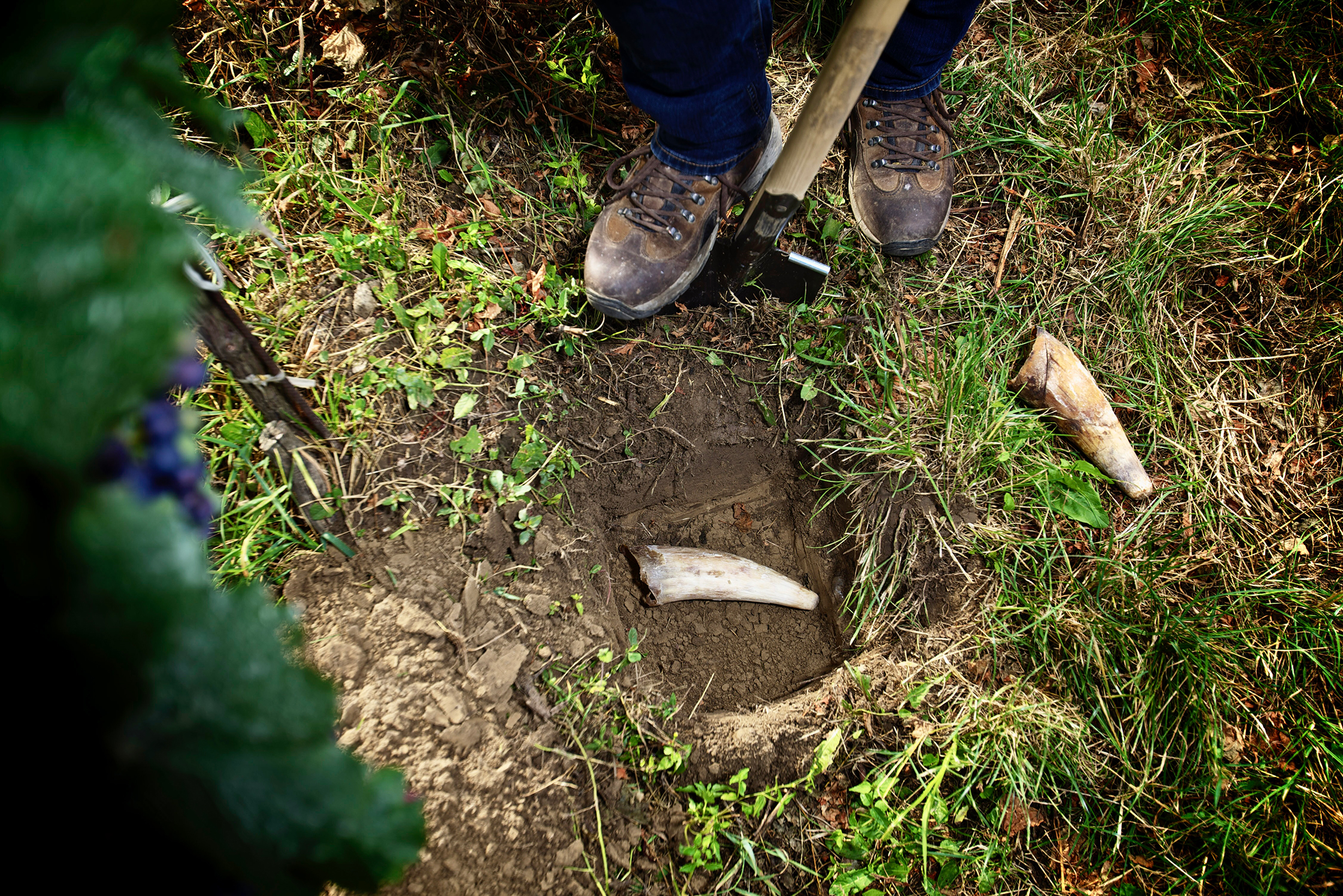
(Biodynamic preps quickie: The famous horn manure, preparation 500, begins with cow dung packed into a cow horn that’s buried beneath earth through winter—often just inside an old barrel or box full of dirt. By spring, it has transformed into a dark humus-rich material that growers dilute and spray across the vineyards, a practice believed to stimulate microbial life, awaken the soils, and encourage deeper rooting. The finely ground quartz preparation 501 is packed into a cow horn and buried throughout the summer before it’s diluted and sprayed. Where 500 speaks to the earth below, 501 speaks to light above: ripening, aromatic precision, tension, and structural clarity. Fermented nettle infusions are used almost like a tonic for the vineyard, believed to stimulate microbial activity and strengthen the vine’s defenses.)

Image courtesy of Fritz Wieninger
Cover crop work is also demanding. In spring, the vegetation grows rapidly, so it has to be mashed down with a big roller, and in early summer, when it gets dry, it may need to be mowed or undercut to regulate water use.
Fritz says budbreak has not changed dramatically overall due to climate change in recent decades, but it does occur about a week earlier in some years. In the past, as now, budbreak could happen in early or late April depending on the year. Harvest, on the other hand, has advanced significantly. Since the 1980s, he estimates it has moved forward by about four weeks.
Not all that climate change brings is dire. Fruit that made it past the gantlet of mildew (which likes the heat) and Peronospora (likes humidity) is picked in warmer conditions. The fruit is often cleaner and easier to sort, unless there’s an unusual weather event that brings bad weather. However, they have much less hang time on average, which, in theory, may affect overall complexity. Green rot and botrytis are no longer as big a problem, either. Rainfall overall is not necessarily lower than before, but Fritz explained that it doesn’t come when needed. The sun’s intensity is much more extreme now, and water evaporates more quickly.
(Vine disease quickie: Botrytis, or grey rot, is a fungus that attacks ripening grapes. Under the right cool, humid conditions, it can become noble rot (concentrating sugars and acids for great sweet wines), but in wetter or unstable conditions, it simply rots the fruit. Green rot generally refers to rot affecting unripe berries earlier in the season. Growers generally combat the “rots” through canopy and cluster management that allows better airflow. Powdery mildew, or oidium, is different altogether. This pale, ashy, dust-like fungal disease spreads across leaves and grapes, disrupting ripening by feeding on the green tissue. Organic and biodynamic growers usually fight it with sulfur sprays, while conventional growers often include systemic fungicides. Peronospora, or downy mildew, is another even more aggressive vine energy thief that feeds on the green and loves wet conditions, leaving oily yellow spotting and white fuzz beneath the leaves. Organic and biodynamic growers typically combat it with copper treatments and careful canopy work, while conventional farming often turns to stronger synthetic anti-fungal systems.)
In terms of holdings, Fritz and his team farm about 25 hectares. About two-thirds of the vineyards for Hajszan Neumann are rented on a long-term basis, and one-third are owned. In the last twenty years, more and more massal selections have been introduced, but the vineyards still maintain more clonal selections.
His vineyard philosophy is highly individualized for each vineyard. He says his vineyards do not look as wild as those of some others who do their work at the last moment. To make world-class wines year in and year out, vineyard work must be planned and executed on time. The greater part of each workday is spent in the vineyards, and he says he’s developed a sense of seeing, and maybe also feeling, what the vineyards need, how they feel, and which vineyard should be worked first. Like many growers who spend more time in the vines than in the cellar and on the road selling, each vine has its own custom tailoring.
He does not plow in the traditional sense and prefers to keep the vineyards undisturbed under cover crop for as long as possible. Plowing takes place only when the existing green is no longer useful, and he’s ready to sow new seeds. This happens at the end of summer in every second row and only in selected vineyards using a spade plow, which fractures and aerates the soil more gently than traditional plowing. New seeds are planted immediately, and then that row is left untouched for the rest of the year.
Picking decisions are always made by Fritz. When taking samples, he tastes the berries, and when he gets home, crushes about a hundred from each parcel, collects the juice, and measures sugar and acidity. Decisions are based on a combination of tasting and technical analysis, and both are felt in his extraordinarily balanced wines.
Wien Geology
Long before Vienna (Wien) became a bustling and important eastern European capital city, it was almost completely covered by a sea until around 13 million years ago, part of the vast Paratethys inland sea system, connected to what is now the famous shallow Neusiedler See basin just to the east. The shoreline corresponded to what is now the higher vineyard area in Vienna. Today, most vineyards are on limestone hills formed from coral reefs and other marine sediments. Often this is combined with layers from an older geological period, around 200 million years ago, when there was a deep-sea valley in the Vienna region. Flysch was formed under strong pressure beneath ancient seas long before the younger marine sediments arrived. Fritz describes Flysch as a sandstone with marl and quartz veins, very common on Nussberg, the main source area for Hajszan Neumann vineyards. Sometimes it appears in layers with marine sediments, and at higher elevations, it becomes purer and less chalk-rich than at lower sites. Vineyards further downslope and closer to the edge of the Danube are fluvial deposits with very little, if any, calcareous influence.
Some wines also come from the left bank of the Danube, especially the “Natural” Grüner Veltliner and “Natural” Cabernet Franc. There too limestone lies underground, but often with thick layers of loess on the surface. This hill is called Bisamberg, and is the easternmost vineyard-planted hill belonging to Vienna. Over hundreds of thousands of years, constant winds from the west blew the calcareous-rich loess from curves of the Danube along the valley, and the material settled on the hillsides of the eastern slopes, creating the loess.
Wine Details

Compelling and undeniably attractive, the nose of the 2023 Grüner Veltliner ‘Natural’ presents more precise aromas than most orange wines, whose nose and palate aromas seem to disperse like an undefined stratus cloud. This is more linear and detailed: dried orange peel and the remnants of Chartreuse in an unwashed glass from the night before, and Austrian countryside in summer: tall white grasses, sun-stressed white and orange flowers, chamomile, sweet, freshly peeled raw carrot, fresh-cut pumpkin and butternut squash.
It comes from vineyards planted in 1999 with southern exposition at 230 to 250 meters on medium slopes over limestone bedrock with medium sandy loess topsoil of low clay content derived from the underlying bedrock. Destemmed and macerated for a two-week fermentation at 22°C maximum, then extended for three months on the skins, it’s aged on the lees for five months, where malolactic takes place before bottling. The first sulfites are normally added only at bottling. It’s neither fined nor filtered.
Upon first crack, the 2024 Grüner Veltliner ‘Nussberg’ is a flood of pleasantries: freshly peeled pear and apple skin, margherita agave and lime, and a palate that matches perfectly, if not more toned down and gentle than the nose. It’s textured and intendedly slightly bitter to enrich the mouthfeel and keep it tight, with austerity, mineral, lemon in the second pour, even petrol. For a difficult vintage, this is not difficult to appreciate—a full capture of pastoral herbs and bramble from the alpine winds, white flowers from the field and garden lattice in late spring. You won’t ponder this kind of wine all day, but you may think about it when it’s gone.
This Grüner Veltliner comes from vineyards planted between 1988 and 2005 with north and south exposures at 230 to 330 meters on medium slopes over Flysch bedrock with deep silty clay topsoil derived from marine sediment. It’s destemmed before three hours of maceration, then naturally fermented in steel for two weeks at a maximum of 20°C. It’s aged on the lees for five months in steel. The first sulfites are normally added after fermentation is finished. Malolactic is blocked. It’s fined with bentonite and filtered.

This yellow-fruited and spicy 2024 Gemischter Satz ‘Nussberg’ field blend of Grüner Veltliner, Weißburgunder, Riesling, Neuburger and Welschriesling is fuller-bodied than the Grüner Nussberg and easier to drink in some way. It’s also not overworked like some Gemischter Satz wines, where the grower pushes texture to compensate for relative neutrality. Instead, this wine rests comfortably in its own gentleness, balanced by opposing varieties of tension and others of softer, rounder disposition, with a palate that expands like the Danube in flood season.
It comes from vineyards planted between 1970 and 2015 with south and east exposures at 220 to 330 meters on steep slopes over Flysch bedrock with deep silty clay topsoil derived from marine sediment. It’s destemmed before three hours of maceration and natural fermentation in steel for two weeks at a maximum of 20°C. It’s aged on the lees for five months in steel and then bottled. The first sulfites are added after fermentation. There is no malolactic fermentation. It’s fined with bentonite and filtered.
There are many more wines in their range, but these are a start. Riesling will be arriving soon, but not soon enough. They’re a real highlight, as any Riesling is in any range of top growers’ wines. The limestone-and-Riesling marriage is fabulous and echoes the greatness found in similar Riesling sites in Rheinhessen and Alsace.
Catch up with Fritz: 2021 – 2025
We asked Fritz to give a rundown of the last four vintages for context and to go as far back as 2021 because I’m crazy about the vintage for Austrian Grüner Veltliner and Riesling further west; I suppose that if you’re reading this, you are too. For me, it’s the vintage of a lifetime for racy but deeply complex wines. Before that: 2013, 2001 and 1999—all vintages I tasted young and still vividly remember in that youthful state after many years of drinking since. When Grüner Veltliner can rival Riesling from the same season, which, for me, a Riesling head, it rarely does, and it did in 2021, it has to be a near-perfect vintage.
Fritz sees 2021 as a very mature vintage with cold night temperatures beginning in early August, followed by a dry, sunny autumn with high maturity, good acidity and freshness. In his view, it was a very good vintage. He’s being modest.
In 2022, budbreak was late, but the growing season advanced quickly because of a warm spring. Summer was dry, and cool nights in early August made it similar to 2021, though more rain came in late summer. A rainy September made harvest difficult, but the damage was not as bad as it could have been. I contend that despite the heat in 2022, it’s a very underrated vintage for many European white-wine regions.
The budbreak was again late, arriving in early May of 2023, with rapid growth similar to 2022. June and July were summerlike, then August became unusually rainy, and hail came at the end of the month. A sunny September made harvest easy and quick, resulting in a good vintage with good maturity.
In 2024, budbreak and spring temperatures were both regular. Summer was cooler, more like what he remembers from the old days. Because yields were low, soil water reserves were good, and September weather was nice, the harvest had to be done very quickly, or alcohol would have risen too much. Maturity advanced extremely fast, faster than he had ever seen before. If one made the right decisions in harvest organization, it was a very good vintage. (His 2024s so far are wonderful.)
In 2025, budbreak came early, but spring was otherwise regular. Good rainfall alternated with sunshine. June and the first half of July were very dry and warm, then the weather shifted to more moderate temperatures and healthy rainfall. Maturity progressed rather slowly. Because growers are now accustomed to climate change, they considered starting harvest early, but then slowed down and didn’t begin the main harvest until mid-September, which is now considered fairly late. Fritz describes the vintage as having good physiological ripeness and moderate sugar, resulting in a lot of fruit and lower alcohol than in recent years. He considers it a very elegant vintage, perhaps not the greatest, but one with very good drinkability.


