Short Summary
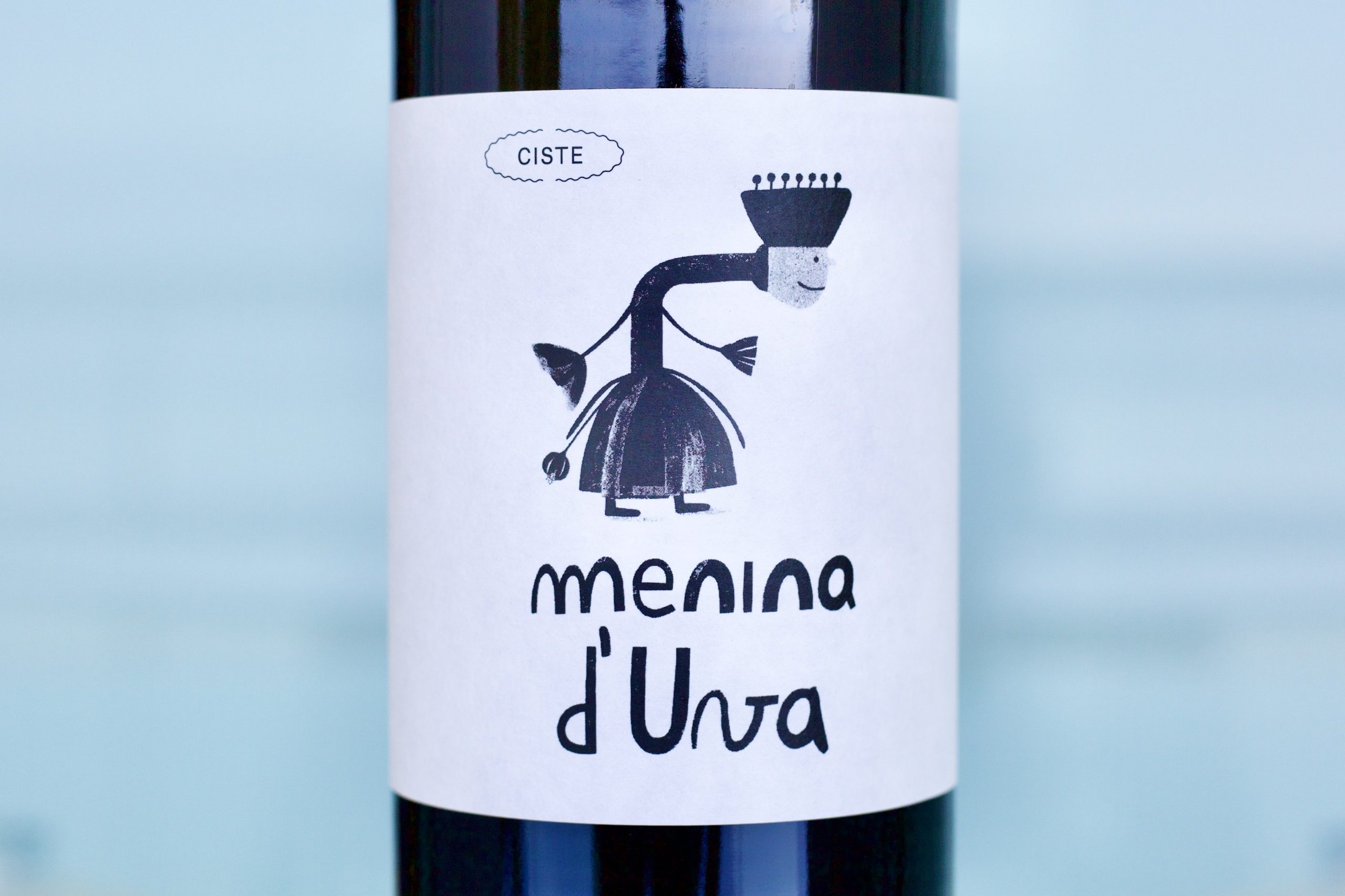
Born in Paris in 1989, Aline Dominguez, daughter of two Portuguese immigrants, returned to her Trás-os-Montes familial countryside village, Uva, in 2017 after completing three master’s degrees in France (including Biology and Fermentation Science) to begin her new life as a vigneronne. In 2018 she began the revitalization of three plots between 30-65 years old owned by other villagers and has since added many more to her roster. Aline works exclusively with indigenous local grape varieties farmed organically on metamorphic bedrock dominated by schist and gneiss and sand, gravel and clay topsoils at an average altitude of 550m in an extreme continental climate just next to the Spanish border. Her wines are field blends gently made with minimal intervention prior to bottling and finished with low sulfite levels.
Full Length Story
In 2017, Aline Domingues left Paris for Uva, a remote village on the Planalto Mirandês, a quiet and mostly desolate countryside in northeast Portugal. Born in 1989, in Cergy, a small suburb about twenty-five kilometers northwest of the center of Paris, she was the youngest of four children born to Portuguese parents. Immigrants from Uva, a minuscule and impoverished ancient village only thirty kilometer from the border of Spain, they came to France in search of better economic prosperity and to escape the dictatorship, like so many Portuguese in the 1960s and ‘70s.
Scientist First, Vigneron Second
Before Aline cut her own first vine and crafted her wine, she became a scientist. She spent seven years between the Universities of Paris Diderot, Dijon, Cergy, and Orléans. During that time, she earned an impressive haul of three Masters degrees in Molecular Biology, Fermentation Science, and QHSE (Quality Health Safety Environment)—the latter of which was more focused on workplace management.
While she was at university, she worked for two years in a laboratory where she studied the metabolism of yeast, and during a school break in September 2012, she worked a harvest in Beaujolais at a domaine that practiced conventional farming—which she immediately realized wasn’t for her. Then, it was during her time at the University of Dijon that she became more fascinated with wine and immersed herself on the subject. Her first official internship was with a Morey-Saint-Denis biodynamic producer, Gilles Ballorin, where she worked exclusively in the cellar.
A Committed Life
In 2015, she met Merlin, the owner of a small watering hole in Paris focused on craft beer, Jura wines and other natural products. With Merlin’s encouragement and support, Aline started to explore the possibilities beyond Paris and what might come of her life with her interest in wine. She took a break from working and hit the road. After a few months she returned to Paris to work at a wine bar to learn more about the subject, from that perspective. Eventually, the idea to go back to her family’s roots in Portugal began to take hold. She considered going to where her grandfather Americo lived, in Uva, but thought that it might be too isolated. The idea of going to livelier regions, like the Douro, seemed more promising. She went to Uva in 2017, anyway, to make an experimental wine with Americo’s grapes. She explained that to make wine with Americo would be impossible because he simply wouldn’t let her do things her way, so she made a hundred liters of wine in a different building that had no power or electricity. That was the beginning of Menina d’uva and Aline’s life in Uva.
With every visit to the girl from uva (Menina d’uva), thoughts of how incredible it is that at age twenty-eight Aline took the leap from Paris, one of the biggest and busiest cities in the world, to Uva, clearly not a common move for a young Parisienne at the start of their professional career, or ever, for that matter; it’s in the middle of nowhere, even for Portugal, a country already on the true edge of continental Europe, and one of just a few European countries bordered by a single country on the mainland.
In Uva there’s a coffee shop/bar in the center of town that never seems to be open, and a lot of not much else other than the beautiful, natural surroundings, and the ancient, yet nicely renovated bright-white structures for housing pigeons, called dovecoats, that litter the hillsides above the town. Aline’s choice was clearly not that of the vigneron inhabiting the modern lifestyle of close proximity to great restaurants and specialty grocery stores; I know from experience that there’s no place for a quick meal and what you can find isn’t going to be light fare. There’s also a dearth of like-minded people nearby—though she does have some cohorts about forty minutes away, at Arribas Wine Company, another Portuguese duo we work with who have the same kind of admirable commitment to working in Portugal’s Siberia as she does. It’s real European backcountry living and one has to be tough to live in the area—not only physically, but also mentally. Aline admitted that she struggled with the decision during her first year. But after that, it gradually became her home.
Uva is a straight shot from the Atlantic directly east from Porto. It’s about two hundred kilometers, or a hundred twenty-five miles, as the crow flies, so it’s hard to accept that it takes about three hours to drive because it looks so close on a map. But the roads zigzag through and around a series of mountain ranges, and while there are a few straightaways (thankfully), it all leads to what seems like an endless maze of rural roads that pass through tiny one-lane villages and over an endless horizon of rolling multi-colored hills patched with fields, picturesque orchards and groves, with hardly a human to be seen outside a passing car. To the other side, on the eastern border of Portugal, it’s Spanish desert, and the closest city is Zamora, the local equivalent to Mali’s Timbuktu.
The Trás-os-Montes and its most eastern subzone, Planalto Mirandês, is famous for high quality olive oil, nuts, meat, sausages, cheeses, and a multitude of crops. It’s also known for wine, but not the kind for those with a low tolerance for high alcohol and the overly flavored.
Menina d’uva’s Wines
While the Trás-os-Montes is known for heavy wines, Menina d’uva couldn’t be much further from that style. Here, she’s begun to modernize the wines in the best possible way: indigenous local grape varieties, organic farming, naked wines made through gentle extraction and a low-tech, heavily thought out, soft-touch approach. The result is wines with soft-colored hues, low-to-medium alcohol with natural freshness and tension. Her wines have heightened aromatic nuances of spring fruits, moorland brush and flowers, with unusually deep minerally and metallic textures that vibrate on the palate.
While Aline’s wines are mostly the opposite of what one thinks of with Portuguese wines, her white, made mostly from Malvasia, is more in line with the country’s white wine style in its texture and more subdued aromatics, as well as its likely natural capacity for the long haul; we’ll see about that in time, given her first vintage is 2018. I admit that I am extremely impressed by the depth and almost invincibility of many of Portugal’s white wines, like those from the Vinho Verde, Bairrada and around Lisbon, and I have a particular fascination with the Colares white wines made from the same Malvasia grape. The only thing that seems to hold back the consistency of older wines is how the Portuguese commonly allow their cellars that fluctuate too much in temperature throughout each year. Somehow in Portugal Malvasia is more attractively made than other parts of the world where there is almost a negative association with the grape for having too abundant of an aromatic sweet floral and perfume punch. They’re different here, as they are in Italy’s Carso, and some neighboring areas of Friuli.
Her red wines, by contrast, are strangers from a distant land. They taste and feel every bit as much like they’re from central or western Galicia, or areas like Saint-Pourçain in France’s Upper Loire Valley, or a Côte Roannaise; or the nearly forgotten Persan from Isère, or perhaps even the Beaujolais Jules Chauvet’s made decades ago (which I’ve only read about)—not only from the alcohol level, but the tensile ripeness and gentle, attractive amargo of the fruit. The aromas in Aline’s reds are high-toned, fresh and bright, even in her Palomba, a darker red made almost entirely of Negreda, a grape variety that is curiously low in tannin for its dark, thick skins. The smell of both is impactful and vibrant, pure and beguiling, like energized spring fruits and the aromas of arid land with sweet red flowers in bloom—this really describes the red, Ciste. Once in the mouth, the textures are unexpectedly concentrated with vibrant, dense mineral and metal impressions. While Aline’s reds are often shy at first, they blossom into wines that are as beautiful and charming as they are contemplative and serious.
Filosofia: Uma Naturalista e Minimalista
We here at The Source believe in and support the philosophic ideals of the natural wine movement. In fact, nearly 90% of our growers work in organic, biodynamic or natural ways; the others who are not are at least enlightened and craft wines no less compelling than the others. However, many winegrowers—especially newer ones—don’t come to the trade with a well-versed scientific understanding or enough experience to carefully navigate what the majority in the industry consider flaws or faults in wines; it’s often more like throwing spaghetti at the wall, or more to the point, at the unsuspecting consumer just looking for a bottle of wine to share during a good meal. Since I began my journey into wine in 1995, I’ve also witnessed many wine quality offenses in other inspired wine movements that came before the popularization of the term, “natural wine.” Some of those who committed early on to the organic and/or biodynamic movement are responsible for some of the worst wines I’ve tasted in my life, while they also made some of the most compelling I’ve ever had. Today, it’s different. Producers and consumers continue to learn and have higher expectations, and the excuses for negligence and blunders are now mostly unacceptable (with the exception of the followers of a few cultish holdouts). Aline aligns with the natural wine movement, but, like us, she posits that wine is a craft left to nature’s desires more than an art, and faulty or bad wine is avoidable and shouldn’t get a pass simply because of its ideological pretense. If only there were more naturistas like Aline, equally committed to science as they are to ideology!
What follows may now be obvious after what’s already stated, but there are no synthetic treatments used in Aline’s vineyards. The exception is the usual inclusion of sulfur and copper, more or less obligatory for all European viticulture to combat powdery and downey mildew if a grower wants to have leaves and grapes on their vines. Since her first vintage in 2018, she’s done a lot of rehabilitation on old vineyards in the area. Prior to her arrival, most of them had been trained toward quantity production and looked like porcupine shoots before she put her clippers to work on them. She’s also planted a few new parcels with massal selections from the area.
Aline’s approach to the cellar is minimalistic. She’s an active observer, taster and tester, but imposes little if any intervention until bottling. The positive consequences of collecting perfectly healthy fruit, proper cellar hygiene and making sure fermentations are clean and efficient is obvious. If those elements are done well, there is little else to do except judicious and precise adjustments until bottling time. Because she just began her new métier in 2018, she sees the need for experimentation and observation to better understand the behavior of the grapes she’s working with, while also letting the wine capture the essence of what she’s farmed with as few unforced errors as possible along the way.
Aline Explains (with slight adaptation)
“The viticulture is completely natural, without any use of chemical or synthetic products. It is aimed at enhancing vine stock vigor by using plant and homemade compost. Life soil is stimulated by restoring plant cover with leguminous and graminaceous species (grasses, or grass-related plants), between the vines.
In the cellar, whole grapes are used for the reds, while the white and rosé grapes are gently pressed with a manual vertical press. The fermentation process is entirely natural, without additional yeasts or additives. To preserve the terroir expression, the wines primarily mature in stainless steel tanks, and are bottled by gravity with a minimal dose of sulfites (30-40 mg/L total), left unfined and unfiltered.”
Lost in Portugal? You are not alone…
If the Trás-os-Montes or, for that matter, any Portuguese wines are new to you, you are in the same boat as a lot of wine professionals and consumers. Frankly, I consider myself ignorant on the subject given that the vast majority of my wine life has been focused on the wines of France, Italy, Germany, Austria, and more recently Northwestern Spain. But what keeps wine interesting to most of us is that there’s always something new around this subject; it’s a choose-your-own-adventure that always reminds us how little we know about the subject no matter how long we study it.
Trás-os-Montes is the obscure within the already globally obscure world of Portuguese wines. (There’s even a wine from the Trás-os-Montes aptly named, The Lost Corner.) This is a consequence of many historical factors, including vine diseases, phylloxera, alien mildews from the new world, wars, poverty, and a dictatorship; you know, the typical European wine region challenges. Also, the commercial wines in Trás-os-Montes perhaps are and may have always been too rustic for the American wine consumer weaned on fruit-forward domestic wines, other more enologically polished wines from famous European regions, as well as various new world wines with more common grape names and familiar euro-phonetics found inside American culture.
After moving to Portugal in 2019 I quickly came to realize that American’s nearly non-existent references to Portuguese culture and language plays a major part in the lack of presence of Portuguese wine in the US market. While every other major wine-producing country in Western Europe contributed a lot of immigrants to North America who brought their cultures along with them—citing especially France, Italy and Spain—whose Romance languages and cultures are ubiquitous throughout the county, Portuguese wine fame is mostly limited to Port wine and to a lesser degree, innocuous bargain white and red still wines.
The wines of the Trás-os-Montes are well known for tasting like not much more than liquid fuel made for the purpose of keeping the field workers going. But before you click away based on this description, there’s hope! Hope in the form of wines like the heroine of this story, Aline Domingues. Her wines bottled under her label, Menina d’uva, are not at all like the wines historically grown in this region. Just as Aline, a Parisienne by birth, sticks out in the area, and so do her wines. But before we dig into her wines, a little foundational material might be useful.
Trás-os-Montes Subzones
The Trás-os-Montes is located in the far northeastern area of Portugal and is bordered by Spain to the east and north, to the south by Portugal’s Douro Valley, and to the south and west by Vinho Verde. Aside from the overarching classification of the wines as the Vinho Regional, Transmontano, it’s subdivided into three main DOC subzones, and spans from the center of Portugal’s northern border to the easternmost area of the country.
Chaves is the smallest of the three DOCs and is located in the most northwestern section of Trás-os-Montes, just across the border from Galicia’s Monterrei wine region, home to the famous and talented Galician pioneer, Jose Luis Matteo, who makes extraordinary wines bottled under his Quinta da Muradella label. In the middle is Valpaços, with a lot of soft hills and waterways, and the DOC subzone furthest to the east and on the border of Spain, is Planalto Mirandês, which sits on a plateau known as Serra do Mogadouro.
Menina d’uva’s vineyards are located in this easternmost subzone, the Planalto Mirandês, just outside and above her new hometown, Uva. This area borders the famous Douro River (known in Spain as the Duero) on the east/southeast side, just across from the new (since 2007) Spanish wine region, Arribes, named after the national park, Arribes del Duero, or Arribas do Douro, in Portuguese. The general landscape of her territory is mostly rolling hills and small valleys created by waterways, like all of Uva, where a small stream continues to flow right by the front of her cellar door.
The Climate
The climate is dramatically affected by the neighboring Portuguese appellation, Vinho Verde. Between the Atlantic and the Trás-os-Montes (which literally translates to “behind the mountains”), and throughout the Vinho Verde wine region, is a series of low-lying mountains that act as a rain shadow that gently squeezes Atlantic clouds before passing through. These mountains, with the highest around 1500 meters but most much lower, cut the precipitation to around two-thirds or less of the average of the Vinho Verde.
While it rains a lot, with an average of more than seven hundred millimeters annually, most of it during around nine days per month between October and May, but it rains an average of three hundred and fifty millimeters on Aline’s vines, so quite a difference! Yet the area manages to be quite arid in the late spring and summer, when there’s an average of only two to four days of rain. There’s also a large topographical variation between more mountainous zones, riverbanks and the plateau. However, in this region they are mostly quite exposed to the elements, especially on the plateau, and in the warmer months there is little influence from the Atlantic. This allows for fewer vineyard treatments than in other wine regions with summer and early autumn rains that result in higher humidity and therefore more mildew pressure. The long, warm and arid summer days are the reason why the wines in the area are notoriously weighty and higher in alcohol compared to those from neighboring Vinho Verde, and are more closely related to Spain’s Duero wine regions toward the east. However, the cool nights that sometimes drop twenty degrees Celsius bring the possibility of freshness to the wines, which Aline capitalizes on and clearly demonstrates in her range.
Trás-os-Montes Grapes
In the 1980s when the cooperativas (co-ops) started their collapse, many grape growers replaced their vineyards to mostly olive trees, the primary agricultural output of this area. Others replanted vineyard land from the historically local grape varieties to more international versions. The move is an understandable one, especially given the highly adaptable blank canvas the Trás-os-Montes offers to the commercially dominant grape varieties, most particularly for reds. With a global market dominated by the now ubiquitous French single varietal wines, any sensible businessperson in search of solutions for a market outside of the country’s impoverished domestic market would consider these international grapes as an option, especially after generations of rigid dictatorship that finally ended in 1974. In fact, the climate and landscape of Trás-os-Montes is quite similar to much of California, so it would make perfect sense to dream bigger and follow the footsteps of the state’s very successful modern wine industry. But one major difference is that California’s consumer populations can single-handedly support most of its wine production and all of the extraordinarily high costs that come with it. The people of Portugal have never been able to follow suit, nor has the country really been able to compete on the world stage to support such a switch. And so the move toward international varieties was short-lived and in the last decades most new vine plantings have been made with indigenous Portuguese grapes. Interestingly, white wine production has been on the increase and has steadily grown from 10% of the region’s output some decades ago to now close to 30%. A lot of these new white grape plantations are at a higher altitude and on hillsides rather than flatter areas.
So what about the local Portuguese grapes with the greatest marketing potential? Well, their first hurdle is that they’re a mouthful us to simply pronounce correctly. Add to that the fact that most of them are a mystery to even Portuguese wine specialists and winemakers; those within specific regions know their own grapes, but because there is so much blending in all the regions it’s difficult to know the specific nature of specific grapes from other appellations. There are literally hundreds of these indigenous grapes that are unknown to all but a few people outside of Portugal.
Here are common Trás-os-Montes whites (you’re on your own with the pronunciation): Viosinho, Arinto, Rabo de Ovelha, Donzelinho Branco, Gouveio (Verdelho), Códega do Larinho, Fernão Pires, Malvasia Fina, Rabigato, and Síria. Some reds: Touriga Nacional, Touriga Franca, Tinta Francesa, Tinta Cão, Bastardo (Merenzao in Spain; Trousseau in France), Tinta Amarela (Trincadeira), Tinta Barroca, Marufo, and Tinta Roriz (Tempranillo). There are many more, but this is a good start.
Menina d’uva’s Uvas…
There is a somewhat large supporting cast of grapes that go into Aline’s field blended wines, a result of the random plantings within the three hectares of vines she farms. The whites are Malvasia, Bastardo Branco, Formosa, and Poilta, while the reds are Negreda, Uva de Rei, Bastardo Preta (Trousseau), Moscatel Preta and Moscatel Roxo. The most important grapes to her wines are Negreda and Bastardo Preta (Trousseau) for the reds, and Malvasia for the white. Her rosé is a mixture of these red and white grapes.
Negreda, also known as Juan García, Mouraton, Tinta Gorda, and other names, was (until Aline came around!) a grape that was previously considered uninteresting because it didn’t produce wines balanced with firm structure, palate weight, and substantial alcohol during its optimal maturity on the vine. But as it turns out, this is quite interesting for today’s wine drinker who favors elegance over power. In general, this indigenous variety with compact clusters and big, rounded juicy grapes is a vigorous plant that also offers a good yield. Interestingly, the biotype in Aline’s vineyards don’t have much natural tannin, despite dark pigmentation and thick skins. If farmed and picked when the acidity is vibrant, like Menina d’uva’s, it’s fresh, bright and aromatic, despite its misleading darker hue. This is the principal grape variety in Aline’s Palomba wine, and makes up a good chunk of her other red, Ciste, and the rosé.
Bastardo Preta, not a very kind name for such a fabulous grape (preta means black, and you can probably figure out the meaning of the other), has many other names, but is most famously known as Trousseau, from France’s Jura wine region. Keeping in mind that there are likely other biotypes of this grape with different properties, Aline’s vines produce small, lightly colored berries, despite what the name suggests, and to add to the irony, the variety is known for its perfumed aromas and medium-colored wines, depending on the extraction level. However, with most red grapes, substantial structure and color is possible if that’s what a producer wants, while others simply don’t have big tannins or acidity by nature. Most of Aline’s Bastardo Preta is grown on igneous and metamorphic rock-derived clay topsoil, which commonly imparts more roundness and flesh despite her very lightly-hued wine called Ciste, an equal blend of this grape with Negreda, in addition to a couple other varieties, including a white.
The white grape, Malvasia, is somewhat well known throughout Portugal and other parts of Europe, but less so in the US. There are a lot of different grapes called Malvasia, and it is likely that many of them are not related; in Portugal and Italy alone there are about a dozen or so grapes associated by this name. In Portugal, it is found in vineyards north to south, with a solid representation grown close to Lisbon, especially within Colares, home to a sandy terroir of own-rooted, ancient vines, both red and white. While perfumed, the grape takes on wonderful textures, and in the case of Aline’s it is not overwhelming, but rather charming and wonderfully textured. The textures in her wines are an unusually strong asset. Perhaps they have something to do with the ground they’re grown on as much as, or more, than on Aline’s winemaking or the grape itself?
The Geology
Geologically, the Trás-os-Montes is part of the Iberian Massif, a remnant of Pangaea, Earth’s last supercontinent that was composed of all of the current continents, a few hundred million years ago. It’s geologically similar to France’s Massif Central (Northern Rhône, Beaujolais and many more) and Massif Armorican (western Loire Valley), and many other European wine regions. Like those areas, it is largely composed of igneous and/or metamorphic bedrock. There are also a lot sedimentary alluvial depositions, especially in the Chaves DOC, which are most often found in and around the small tributaries and the main river, Tâmega, known for its hot springs (so naturally the Romans left traces in the area), which starts in Galicia and eventually joins the Douro, to the south.
Within the Chaves DOC subzone, vineyards up and outside of the river’s influence are mostly composed of igneous granites or granodiorites (a rock that looks like what we commonly call granite, but differs slightly in its mineral makeup), and a smaller proportion of metamorphic rocks, perhaps predominantly graphite schist. Because the Chaves DOC ends at the northern border where Spain’s Monterrei DO begins, the bedrock can be similar in Monterrei from an overall geological perspective, but there is an increase of metamorphic rocks found here in addition to the intrusive igneous rocks, like granite or granodiorite.
Menina d’uva Vineyards
Valpaços (an evolved compound spelling of Vale de Paços) has a large variation of vineyard settings with a mixture of some on very flat areas and others on softer sloping hillsides with high desert landscape. The range of vineyard altitude is between two hundred and seven hundred meters. The area as a whole has a broad geological diversity typical of the area with most of the bedrock either igneous or metamorphic, the latter predominately quartzite and graphite schist. Like the majority of Trás-os-Montes, Valpaços most commonly produces sturdy, rustic wines, while a few others take a stab at international varieties.
Planalto Mirandês is where the geological fun begins, not only because we have two winegrowers there in somewhat close proximity, but also it seems to have a different energy and quite a different setting than the other two subzones in general. The other winegrowers we work with is a dynamic duo Aline introduced us to who also started their project not too far from her, but on a completely different geology and topography of vineyards, called Arribas Wine Company. I understand why three young, globally minded wine fanatics in search of a place to set up shop might choose to go there. Nature abounds. It’s serene. It has a beautiful countryside with a big sky. There also seems to be endless possibilities with such fabulous dirt and weather for grapes, and a multitude of grapes to choose from. And many of them are ancient vines that quietly survived through the years while others were replaced with international varieties, or varieties from other Portuguese regions.
From a geological perspective, depending on location, most vineyard bedrock and soil is igneous granite or granodiorite, and the all-star cast of metamorphic rocks: mostly schist, but also a lot of slate and gneiss. The real difference here is the locations. The steep, southerly- exposed barren granite hillsides where Arribas Wine Company’s vines overlook the Douro are quite the opposite of Menina d’uva.
A Deeper Geological Dig
Valpaços just touches on the eastern side of what geologists refer to as the Morais Complex, while the Eastern half of the Planalto Mirandês DOC sits inside this geological formation. On geological maps of the area, there are two “complexes,” the bigger of the two, a concentric (circular) in the south, called the Morais Complex; and in the north, an ellipsoidal (oval) formation, called the Bragança Complex. Both complexes are allochthonous, a term that simply means these formations originated somewhere else and were moved to where they are today, usually by mountain forming events, which geologists call orogenies. We’re in deep now, and geological terms like these will pop up more along the way as we dig into other regions, too.
The Morais and Bragança Complexes were part of an oceanic plate underneath the ancient Rheic Ocean. The Rheic was between the two supercontinents, Laurasia (home to today’s North America, Europe and Asia, minus India) and Gondwana (Africa, South America, Antarctica, Australia, India). During the millions of years of smash-up between these two continents most of the oceanic plate below was destroyed. However, some parts of that plate survived and were uplifted and scattered through northwest Iberia. What’s left are complexes like the Trás-os-Montes, and the Cabo Ortegal and Órdenes Complexes are on the northern most area of the Galicia, by the cities of A Coruña and Ferrol.
So, why bother with these complex complexes? Well, because they have very different rock types than the rest of Iberia! Some of these rocks unique to this area are mafic igneous rocks, like gabbro and basalt. These rocks are darker in color due to their mineral makeup, and have an alkaline pH—the latter being a little unique in this igneous and metamorphic land dominated by rocks with acidic pH levels. Surrounding the Morais Complex are the remnants of the Gondwana and Laurasia collision, which generated a broad range of schist, slate and gneiss formations related to this event.
Back To Aline’s Vines!
Menina d’uva’s vineyards are on the furthest eastern edge of the Morais Complex, largely atop metamorphic bedrock. The vineyards are on rolling hills and soft slopes, with deeper topsoil than what is found on more extreme hillsides. Most topsoil between her many parcels is composed of severely eroded metamorphic rocks that have remained in place, while other topsoils are clays and other depositions originating elsewhere. The soil grains of her vineyards range from clay, sand and various sizes of broken up schist, slate and gneiss. This mishmash of bedrock and topsoil grains with variable depths bring a broad range of textures and weight to Aline’s wines, despite their soft extraction.
Many of her vineyards have olive trees planted in or around them, and other crops close by. With respect to a quality of biodiversity standpoint, Menina d’uva’s vineyard land is a model to follow in areas where crops cover the landscape wherever vines aren’t planted. Arribas Wine Company is another contrast to this in that most of their vineyards are alone in the wilderness with its neighboring land consisting of mostly abandoned vineyards reclaimed by nature—a different biodiversity but of equal contribution for those in search of authentic wines with a clear terroir voice beyond the grape, vineyard composition and cellar tinkering.
Aline On Her Terroirs
“In 2018, Menina d’uva produced its first wines by bringing back to life three plots of old vines owned by other village residents. Since then, three additional vineyard plots from neighboring villages, supplement the production for a total of 3 ha (~7 acres).
The old, native vine varieties around Uva and much of the Trás-os-Montes are deeply adapted to the climate and soil, and between thirty to sixty-five years of age. They mainly grow on schist and quartz soils, which allow for deep root infiltration. Some plots are located in the occasional sedimentary cover of the region. These soils have less depth, but are more fertile, characterized by increased water circulation and retention.
At an average altitude of five hundred and fifty meters, the old vines benefit from a continental climate, marked by long, cold winters and warm, dry summers. The large variations between daytime and nighttime temperatures promote slow grape maturation.” -TV
Menina d’uva’s wine details are covered on each product page.
Thank you to Ivan Rodriguez, MSc Geologist (with a PhD en route! Go Ivan!), for his contribution with some of the geological content.