


Download May 2026 Newsletter
White Knuckling ’till June
The 2026 growing season started early this year in much of Europe. For growers, this is always exciting: the birth of a new chapter in the history books and their life as vignerons—a time of unknown potential. But these days, especially over the last fifteen years or so, anxiety often rises to surpass the level of excitement. Frost has always been around, but vineyard vegetative cycles are activating about a month earlier than they did thirty years ago in many places, making them more susceptible to damage. While the earth is warming, it’s the erratic weather events that make it especially precarious, like early heat spells at the beginning of spring or the end of winter, followed by freezing systems moving in within days. Pruning later and direct combat with sprinkler irrigation to freeze an ice casing around the plant’s new tissue, wind machines, and big “candles” (bougies antigel, in French) that are actually large cans filled with paraffin wax, for heat. Secondarily, the smoky haze that occurs in radiation frosts (those where mornings and nights are cloudless) can assist, but if the tissue is completely frozen overnight, you are already lost. And there was another particularly challenging factor I hadn’t considered with this extremely early season.
To mitigate my serious allergy problems, I usually plan a series of visits in March and April to thread the needle between cypress blooming in the late winter or early spring and the grasses and flowers that kick off in mid-April to May. But because of this early season, I got crushed over five weeks in March and April on the road between Portugal, Spain and France, and went through at least six boxes of allergy pills. With the strong winter winds that never seemed to end, blowing cypress blooms all over Europe, I’ve felt under the weather since early February. It’s not been this bad since I was first affected at 27 by airborne allergens in 2004. That year, I couldn’t smell anything from March through June.
Champagne and Chablis got hit hard by frost, and Jura and Burgundy leapt into action to prevent what happened further north and west. In the Loire Valley, one of our favorite growers, Vincent Bergeron, came home to Montlouis after a week up north with his nuclear family and mother, expecting only small losses, but ended up losing 50% of the biggest parcel and a little less on the others. For growers with productions as small as his, this can be the difference between making money in a year’s work or not, but still having to do all the work in the vineyard through the season, while ending up with a major reduction of fruit. Fingers crossed that May is uneventful.

Nicolas Renard thieving from his barrels—Vincent Bergeron and company patiently awaiting their turn at enlightenment.
2025: Best in how long?
During my spring trip through western Europe, it became increasingly clear that the 2025 vintage reports are going to be maxed on stars, particularly in France. Crops had smaller yields than usual in many areas but seemed almost universally good across the regions we covered on our April loop.
A regular joke in the trade among importers and distributors is that the best vintage is always the one we have to sell. But in Burgundy, it seems everyone is always so much more excited about the future than what’s in hand. My timing for tasting the 2024 Côte d’Or wines was off, as many of the wines were just prepared for bottling or had just been put in bottle. Regardless, it’s the third time I’ve tasted them and the third time I’ve left excited about these classically styled wines. Then, my second trip to the cellars to taste the 2025s for the second time since harvest again brought some perspective.

Rodolphe Demougeot’s stunning 2024s are heading to our shores soon, and his 2025s out of barrel were off the charts.
(Though he may not show it sometimes, he does like having his picture taken …)
All the reds smelled and tasted like their respective terroirs, but, uniquely, they’re fleshed out and full, like juicy vintage red-hued Vosne-Romanée wines—exciting and a load of fun to taste, even at nine in the morning. 2025 secured a threepeat win for Pinot Noir from a qualitative standpoint following the variability of 2018 to 2022, even if the yields came up short, and 2024 suffered massive losses, particularly in the Côte de Nuits. But with the separation between 2023, 2024 and 2025 reds, as of now, a year before the 2025s are bottled, it seems the alpha is still in barrel. There’s no doubt in my mind that the marks should be massive for the 2025 reds and the speculation is high. The white Burgundies of 2025 are solid and pure, but in my view are no match for the striking and classic 2024s, which many vignerons also believe produced the best overall season for Chardonnay since 2014. I agree, though 2024 may be even better in some cellars in central Burgundy than any year over the last decades.
My wife and I started in Provence and worked our way up through Beaujolais, Mâconnais, Côte d’Or, then over to Jura, up to Alsace (yeah, we’re on the verge of inking a deal there with a very unusual project with awesome wines—a tough region to sell, I know, but this duo is thinking well outside the box with wines that match their gorgeous labels), then over to Chablis and Irancy, Pouilly-Fumé and Sancerre, Montlouis, Saumur and Anjou, a weekend in Normandy (first time, definitely going back!) then down to Bordeaux, further down into Jurançon, back up to Cahors and then back home to Catalonia.
In Burgundy, we visited a few of our new growers whose first vintage was 2025—an easy and deceiving intro into their chosen métier. Of course, I told them to remember that this castoff year for them is indeed something quite special—perhaps the best universal year for quality in France in a few decades—and to be prepared for the law of averages to come.
The only thing that gives me pause to call it one of the greatest over the last decades, is that most wines tasted almost too good too early—the only foreseeable canary in this coal mine full of diamonds. Regardless, 2025 is a special one.
New Arrivals
After the opening segment on the 2023 Bien de Altura Canary Island wines and their maker, Carmelo Peña Santana (visiting New York and California this month), I want to introduce a few new must-haves for any Italian wine lover—special wines, though unfortunately in very limited supply.
Bien de Altura | Islas Canarias
The Shape of Ascent
2023 Gran Canaria Wines
This month, New York and California will be visited by one of Spain’s fastest-moving winegrowers. Carmelo has become a great friend, but aside from that, his Canary Island wines are thrilling examples of what can be achieved on this archipelago just west of North Africa. Today, they capture attention wherever they’re found, and the world is starting to pay attention to what he’s doing, so much so that he’s already presold all of his 2024 and 2025 vintage wines, and we’re just starting on his 2023s.

The old label and the new (on the right). ¡Hasta luego, piernas!
With the 2023 vintage, he changed the labels to reflect more of his process and the seriousness he’s always taken in his craft. His whimsical early labels may have given a misperception of the wines, even if the wines were seriously good. And because he felt like he was put into the “natural wine” category by many despite the classic craftsmanship used in the cellar, he decided it was time for a change. Adorned with the native Guanche alphabet, surrounding a compass of sorts, with a black tip that points the direction of the vineyard aspect, as well as the altitude listed in meters.


The Terroir
Gran Canaria is one of seven islands in a volcanic archipelago off the coast of Africa (directly west of southern Morocco and north of Western Sahara), formed by what began as constant underwater eruptions that developed into islands through continued tectonic separation along the Mid-Atlantic Ridge. Africa and South America broke apart and continue to move away on the Atlantic side by about two or three centimeters per year. Gran Canaria is almost right in the center of the archipelago, between the two desert islands to the east, Fuerteventura and Lanzarote, and the islands to the west that become more tropical the further from Africa they get, like Tenerife and Las Palmas.
Temperature is also a major factor, and not surprisingly, the altitude of each plays a major role. Among the main wine-producing islands, Tenerife has the highest peak by a large margin, with Mount Teide hitting 3,718 meters (12,198 feet) with peak temperatures in the low 40s Celsius and the lowest recorded temps nearing -10°C. La Palma has the second-highest peak, Roque de los Muchachos, at 2,426m (7,959 feet), with the peak temps hitting the low 40s and the lowest at -3.7°C in January 2021. Gran Canaria is the third-highest island with Pico de las Nieves (Snow Peak) reaching 1,949 meters (6,394 feet) with peak temps in the mid-forties, the lowest also -3.7°C in January 2021, while Carmelo was pruning at around 1300m altitude. Lanzarote, the most desert-like viticultural island, peaks at 671m (2,201 feet) at Peñas del Chache, with highs in the low mid-forties Celsius and its lowest recorded temperature of 8°C. All the islands with higher peaks will naturally have the lowest temperatures in certain spots during the winter.
Gran Canaria is a circular island with extreme desert on the south side and a pocket of tropical green (though still more desert than tropical) on the north side. Gran Canaria is not as famous for wine growing as Tenerife, but Carmelo is changing that.

A Mother’s-Made Man
Raised by his mother and grandmother, Juana and Lola, respectively, Carmelo inherited from them a big heart, warmth and charm, and the streets of Las Palmas de Gran Canaria, the inner city energy and hustle of this island industrial port scrunched between the quiet volcano and Atlantic crammed with half a million locals and four million tourists each year into its one-hundred square kilometers (~38 square miles).
Carmelo returned home to Gran Canaria to begin Bien de Altura after traveling the world, including harvests in the southern hemisphere and finishing his “practical” studies with the Portuguese wine luminary Dirk Niepoort. At Niepoort, he befriended Dirk’s right-hand man, our very own Luis Candido da Silva, the toiler and mind behind Quinta da Carolina. It was also the beginning of El3mento, a project Luís and Carmelo started, and has now expanded to include close friends in Chile and Switzerland. Immediately, Carmelo turned heads with his own-rooted vineyard wines that expressed the same bright and generous personality of their maker and the Listán Negro grape.
Listán, What?
Listán Negro is the dominant grape on the island and in Carmelo’s wines. Listán Negro results in more elegant wines with a fresher fruit profile, while another famous Canary Islands grape, Listán Prieto (País), at least when compared to Listán Negro, produces a more robust, deeply complex, and fuller wine. (Side note: In Chile’s Itata Valley, País (Listán Prieto) grown on volcanic soil is much more elegant than those minerally and more rustic versions grown on Itata’s granitic soils.) The key to keeping both varieties aromatically pure and gentle on the palate is a vigilant tasting regimen during fermentation to prevent either variety from getting carried away on tannins and reduction before pressing, especially Prieto. However, under Carmelo’s watchful eye, the combination of the Canary Island varieties cofermented and untouched (unless necessary due to imposing reductive elements) during their month-long vinification before pressing usually does the trick. Without a clear idea of the cause, Carmelo often says that the volcanic wines produced in Gran Canaria are less expressive of reductive elements than those of Tenerife, the more famous island with many great producers and vines. Carmelo also makes a white from Listán Blanco, more commonly known in Spain as Palomino, but it rarely leaves the island.
Vineyards & Wines
Carmelo focused his initial research on old vines in the higher-altitude areas on the northeast side of the central area of the main volcanic cone, about four kilometers from the peak, Pico de las Nieves. Since he started in 2017, he’s amassed more vineyards and continues to seek out new parcels. Today, he makes five different red wines from the island, four from single-vineyard plots. Each parcel is, of course, on volcanic soil, and because there is no known phylloxera on any of the Canary Islands, every vine is own-rooted with what we would call, “indigenous” vines; perhaps “first-known generation” could be more suitable because there were no vines before the arrival of the Spaniards, who supposedly first arrived in the 15th Century after the conquest of the islands. There are historical documents, such as the writings of Pliny the Elder, that the Romans at least knew about the islands, though they may not have inhabited them. The timing of the Spanish invasion of today’s Islas Canarias also coincided with the exploration and settlement of the Americas, where they also planted vines around the same time, with Chile as another unique region (in this case, country!) suitable for quality viticulture void of phylloxera. Chile is also home to perhaps the world’s oldest living vines: País, the same as Listán Prieto.
(Interestingly, many Spaniards from Andalucía populated the Canary Islands, whose descendants then populated Chile. This is probably why the Chilean accent and some cultural terms closely match the Canarios.)


Ikewen
With its new label, a break from the already iconic label in the natural wine world’s rarities, Ikewen is a name bestowed in honor of the island’s Indigenous Berbers and/or Gaunches peoples, which in both languages means “origin.” Carmelo’s stable of vineyards continues to grow, and what was composed of three different vineyards only a few vintages ago is now taken from seven on the northeast side of the island (like all the parcels) with an average age of forty years with some over one hundred with own-rooted (pie franco, like all the vineyards) 85% Listán Negro (the elegant Listán) and 15% of other rare “first-known generation” varieties. The altitude ranges from 1,100-1,460 meters (3,600-4,800 feet) on mostly east-facing sites, on extremely steep orange volcanic sand, silt, clay, and rocky topsoil.
While the single-parcel wines have distinctive personalities and go in a straight line, the parcel blend of Ikewen is the most universal. In smaller doses inside this vineyard ensemble, it hits the highest of the high tones and the lowest of the low tones in the entire range. The fruit profile meanders between pale red and slightly dark red, and its subtlety is supported by a dynamic structure. All the wines are interesting and complex, but the combination of all seven parcels makes it particularly special. It’s by far his highest-production wine, but it may remain the most compelling simply because of its completeness and balance.
Tasted recently, the 2023 Ikewen was pretty and totally open straight out of the gate, with a big palate texture for the light color and nose. The herbal notes are beautiful, and the overall profile recalls some granite wines by Comando G I recently had at their cellar just a few weeks prior. At 12% alcohol, the characteristics feel melded together in a harmonious, analog way. After about ten minutes, the volcanic soils begin to show more clearly, and the structure starts to build, though it remains softer than the 2022 and comes across as more finely tuned than the more structured and well-built 2022. Here, the 2023 is very floral and fine, with an iodine-tinged palate. Among the range, it remained the most complete, with exotic blue and red fruit—purple grapes and Persian mulberry.
On the second day (about eighteen hours later), it remained just as pretty—gorgeous, in fact. The tannins stay chalky and fine but show more presence on first taste, and the aromatics broaden into orange, persimmon, pink and red rose with a dusty, lifted character. This is one of those wines that look like nothing but taste like everything, recalling in some ways Cume do Avia’s Brancellao; or for those in need of a Burgundy reference, early 2000s Mugnier Chambolle—light to almost no color with plenty of aromatic thrust and substance on the nose and palate.
Once harvested, the whole-bunch fruit for Ikewen is fermented for five weeks in steel without any intended extractions: only a gentle pressing of the cap a dozen centimeters down by hand to keep it from building bacteria or volatile acidity in the upper and more exposed area of must/wine. After a gentle final pressing, it’s aged for a year in 85% steel and 15% in 225-500L old French oak and is neither fined nor filtered before bottling.
Single-site reds
Three of the single-site wines, Tidao, Agan, and Sansofi, are vinified for a five-week whole-bunch fermentation/maceration in open-top 500L French oak barrels, followed by aging one year in 225-500L old French oak. Like Ikewen, they are neither fined nor filtered.

Tidao
Often the most tantalizing and charming, sour red candy, red flower red in the range, Tidao comes from an own-rooted, 120-year-old single parcel (2024) on the northeast side of Gran Canaria, planted with 70% Listán Negro and 30% blend of the reds, Tintilla, Listán Prieto (País), and Vijariego, and the whites Listán Blanco and Malvasia on a moderately steep undulating slope facing southeast at 1050-1070m on volcanic scree (breccia) bedrock with clay and silt topsoil. Important note: it’s a beauty and completely gulpable, so be careful with your company to ensure everyone is measured, and of the sharing type.
The 2023 Tidao is Tidao: sensual as hell and one of the most authentic wines from Spain, with a sappy, suave palate that makes it a slam dunk wine. The fruit profile leans equator-close and exotic, with guava, mango, even a bit of pineapple skin, prickly pear, ciste flower, dried porcini, and warm, wet, sun-weathered volcanic earth held together by a medium structure with slightly chunkier tannins. On the second day (about eighteen hours later), it showed more structure and was a little less giving, though still very pretty. I expect a great future for this wine if anyone who buys it can keep their hands off of it.
If Tidao is Carmelo’s ethereal charm, Agan (no longer made) his contemplation, Ikewen his balance, then Sansofi is his ideal; it has the best of each in his range found here, but within a tighter framework. A ninety-year-old parcel (2024) planted to 85% Listán Negro and 15% Listán Prieto and Listán Blanco between the El3mento parcel and Ikewen vines on a medium-steep slope facing north at 1330-1365m on volcanic bedrock with picón, sand, clay, and silty red topsoil. This is the unique wine in the range that faces due north. Like Agan, Sansofi needs more time to open than Tidao and Ikewen—again, it’s best to share with fewer people.


The 2023 Sansofi shows more structure immediately, compared to Ikewen, coming across more mineral and drier from the outset—a deep dig into the mountainside: wet and cold rock, iodine, mineral and metal, all with a kind of diamond-blade precision. This strikes me as a tasting-menu wine rather than a single-table journey—best served in smaller pours, like a slice of beautiful sushi, two bites, admired, and then moved on from.

With four hours open, both Tidao and Sansofi began to fill out and display their restrained power more clearly alongside Ikewen. On the second day, Sansofi showed a touch of wood with tighter tannins; still an immensely pretty wine, though less immediately compelling, even if, after several hours open the previous night, it shone very brightly. Like Tidao, this bottling should be left alone for a few more months while we all swoon over Ikewen.
El3mento
El3mento is a project developed by Carmelo and Luís Candido da Silva, who met while at Niepoort in Portugal’s Douro Valley. Today, this project has extended to Portugal’s Vinho Verde, Switzerland and Chile’s Itata Valley, where these friends make their wines the same way, with long whole-cluster post-fermentation macerations in amphora.
Carmelo’s tribal wines, 2023 El3mento Gran Canaria, are also outliers in style. The 2023 El3mento Gran Canaria is led by bright floral notes and earth and was aged for eight months in a 1000L amphora with the whole clusters, remaining unmoved, with only the free-run wine kept for the final wine. It’s composed entirely of Listán Negro planted forty years ago (as of 2026) on an extremely steep slope adjacent to Sansofi but on the other side of the hill facing southeast (Sansofi, north). It shares the same volcanic picón, sand, clay, and silty red topsoil as the other wines, but with a higher concentration of large volcanic rock.
Alberto Oggero | Roero
Nebbiolo in Zero Gravity
(Available from The Source only in CA)

For our company’s own self-interest, I’d be wise to keep quiet about Alberto Oggero until I secure more of his future production. There’s no doubt in my mind that droves of importers worldwide will come to understand this is not one to sit out, and I will be fighting for every bottle. But I’ve never considered myself to be wise, and I can’t stay silent about Alberto and his utterly captivating wines. After all, it is not my job to keep quiet.
Immortals seared into memory
Sitting in the dark, two Zalto Burgundy glasses shimmering in the candlelight and holding the two beautifully crystalline and lightly hued Le Coste and Anime, Alberto prowled back and forth from cantina to table under a starry night after one of the summer’s longest days with his partner, Camilla. Occasionally eyeing my progress (or perhaps what seemed to be the lack of it), everything had to be perfect—an isolated stage for the two wines in front of us, candlelight standing in for limelight, and time to take them in.
Deeply entranced by the aroma of this pair, it was hard to break from their sheer aromatic perfection by risking a sip too soon. But we had time. Fifteen minutes in, I still feared moving from one of the purest aromas I can remember to potentially spoiling the dream state with a palate that might not match.
En bouche, wines don’t always deliver on the promise of a transcendent nose—like a wonderful first date with a longtime interest that deflates with the first kiss. Thank Dionisis—this was not one of those times. That moment was and will remain one of the most extraordinary side-by-side contemplations in any young wine’s life I can remember—a near nirvana moment, not a single element of either wine distracted from its focus and purity.
In the elegant genre of red wine, these set the bar. Not only for young Nebbiolo, but for any red wine, these two masterfully crafted Roero Nebbiolos embody almost everything I seek: purity, generosity without overindulgence, subtlety so deeply complex it’s profoundly simple at the same time and tightened with a slight austerity to keep in the conversation of the world’s most gloriously crafted wines.
Waves of Sand
Once in the vineyards, one can’t help but think that Alberto must be a little crazy. With these calcareous Roero sands somehow remaining plastered onto hillsides that crest like monster swells at Nazaré, it’s almost unimaginable that vines could last more than a few years bolted into such vertigo-inducing earth; even more unimaginable is how people could work some of these vine cliffs without gear to root them to the slope, let alone consider a tractor. But once the wines are in the glass, his madness is clear: he’s driven by his curiosity and the pleasure for all those who seek his wines.

Minerally, salty, and finely textured, Alberto’s Roero Arneis is drawn from two vineyard parcels with an average vine age of 20 years. Like the steep, sharp hills it’s planted on, it expresses a duality between the richer influence of the sun on the parcel that faces south, the alpine freshness of early morning sun, and the shaded afternoon of the southeastern face. As it’s written on his website in Piemontese language, “A taula s’ven nen vec”—at the table, one never gets old, “It is designed for the everyday table and to accompany the entire meal—a faithful tool in our mission to offer a ‘superior drinking experience’ for every occasion,” and that’s exactly the way this fuller flavored Arneis feels.
The south-facing parcel of Arneis is destemmed and gently pressed, while the southeast-facing parcel is destemmed and lightly crushed before fermentation. (Before 2022, the grapes for this wine were macerated for a few days before pressing; today, that approach is reserved for his skin macerated Arneis Valle dei Lunghi.) Fermentation takes place in stainless steel, with each parcel vinified separately. The wines are then aged separately in concrete on fine lees through the winter without racking or bâtonnage. In the spring, they are racked, blended, and bottled. A light filtration is carried out before bottling, with no fining.
Nebbiolo Aérien
Rich in character like Alberto’s Piemontese-laced accent, his Nebbiolos seem to speak Piemontese themselves—Italian in pointed clarity, French in subtle inflection. Named after his grandfather, Sandro is a gorgeously lifted, bright, pure red Nebbiolo—almost pink. One thought that crossed my mind while fawning over this wine was: why even bother with other grapes in Roero and Langhe when Nebbiolo can stretch this far, from something so intentionally pure and simple and beautiful like this wine, to the deepest, most age-worthy expressions? Piemontese Nebbiolo simply must be the most versatile red at this time in climate change history: compelling across any kind of geology—from igneous to metamorphic to calcareous sedimentary formations—across sands, clays, and even glacial deposits; in mountain, Mediterranean, and continental climates; from 12% to 15% alcohol; bright and fresh or deep and contemplative, in bubbles, rosé, and still. What other red grape matches that and delivers on all fronts?
With strawberry skin, pink plum, Persian mulberry, sweet watermelon rind, hints of Aperol, it’s so hard to move past Sandro’s wiry strings of pink and soft red fruit and flower, like a finely cut pink diamond. Simplicity at its truest perfection. In this case, a dainty rosa selvatica. The problem? A 750 ml bottle seems barely enough for a night to yourself.
Sandro is harvested from 25-year-old vines planted on a southern exposure on extremely steep calcareous sandy hillsides at 280 meters. The soil is more than 70% sand and silt, resulting in less color, less tannin, and an overall gentler wine than Le Coste and Anime. In the cellar, it’s destemmed, and fermentation takes place in concrete with submerged cap maceration and no pump-overs or forced extractions. The wine remains in concrete throughout the winter without racking before bottling the following spring. Le Coste and Anime have a touch more clay but are still mostly sand. In the cellar, these two wines are handled similarly but undergo a few daily pump-overs during the first few days before the cap is submerged, and they’re left untouched toward the end of fermentation. After pressing, they age for 12 months in large oak casks, then for six months in concrete before bottling. None of Alberto’s Nebbiolo wines are fined or filtered.

Like all great duos in an inspired grower’s range (Allemand Chaillot and Reynard, Veyder Brandstatt and Buschenberg, Dauvissat Preuses and Clos, Schaefer Domprobst and Himmelreich, to name but a few), between Alberto’s cru Roero Nebbiolos, Le Coste & Anime, I don’t believe one is better than the other. Side by side, the differences are clear, but they’re twins in different clothes. And the way they’re dressed can make the vanguard of finesse-driven Barolos and Barbarescos seem overwrought, even a bit clumsy.
Harvested from 40-year-old Nebbiolo vines on an extremely steep south-exposed sandy slope at 320 meters, Roero Le Coste has the vigor, the tension, the aromatic lift, the brighter octave—it’s the first wine listed among the parallel duos. If you tend toward the upper row premier cru body over the grand cru, the beguiling, the pure distillation of pointed aromatic notes and a finely sculpted body, Le Coste is where you start. Between the two—and considering that Anime is still very close in overall style under Alberto’s hand and the hill next door—the aromatic fireworks and undeniable charm and finesse, the seemingly carefree perfection that makes the 2023 Le Coste stand out in the world of Nebbiolo wines from Piemonte.
If Le Coste is the violin between Alberto’s duo, Roero Anime is the viola. In Nebbiolo terms, both have a lifted perfume, but Anime’s has a light shadow. Like Reynard, Buschenberg, Clos, and Himmelreich, Anime plays the same music in a slightly richer register. Because it’s grown and crafted identically to Le Coste, the differences reduce to a few: southwest exposition on a steeper slope inside an amphitheater versus Le Coste’s well-ventilated south exposure on a slightly less extreme slope (though still extremely steep), the concentration that comes with 100-year-old vines against Coste’s in their mid-thirties, and the incredible vine density of Anime’s 10,000 vines versus Le Coste’s 4,000 vines per hectare.


Purchased between 2015 and 2019, Anime’s steep southwest amphitheater-shaped slope is fully and directly exposed to the setting sun and its warmth, while Le Coste turns toward the south, casting an earlier shadow of relief during peak summer stress. And even if the 10,000 vines per hectare offer more refuge from the sun because of their close proximity to one another, the extended warmth caught by Anime’s southwest-facing amphitheater pushes the fruit a shade further in ripeness (even if still gloriously red across the board, just a bit sappier than Le Coste), which brings out a deeper, more resinous aromatic register.

Though I can’t pick a favorite, the allure and wisdom of Anime’s hundred-year-old vines planted at such a very high density—nearly double the region’s standard—the complexity and concentration even on this frame, so dainty compared to Barolo and Barbaresco, are undeniable. The depth and weight captured in its lighter frame only magnify this achievement.
Alberto has courageously managed to do what few growers in Roero even attempt: to be itself, not to try to be Barolo and Barbaresco; to magnify its natural qualities (lift, tension, purity), even if it doesn’t cater to tasters who prefer more robust wines. In recent decades, I’ve seen a segment of the wine world gravitate toward terroir expressed through weightlessness and nuance more than density and weight. Though long known, we’ve rediscovered that one of the keys to zero gravity wines with infinite pleasure and richness in terroir expression is found through the lens of sand—a fine grain, once a rock, where air and water pass through with ease, yields wines that mirror its physical properties—lifted, ethereal, fine; a weightlessness without losing structure that the French describe as aérien.

Unlike Sandro, because there are so few bottles of Le Coste and Anime, they should be shared with your favorite friends—preferably those who know when to leave it unsaid and enjoy the magnificence of these two wines. Indeed, under a starlit sky on a warm summer night with their gorgeous crystalline ruby red heightened by candlelight? Perfect.
Sergio Arcuri | Cirò
Gaglioppo is coming
(Available from The Source only in CA)

Sergio Arcuri and I endlessly knocked the foosball back and forth about how to properly promote Cirò, one of Italy’s significant remaining secrets. Cirò’s arid climate in some years requires no treatments, and in most years only a few compared to 10-17 passes in places further north, with almost all of the organically-minded European growers. This is perfect for anyone searching for high-quality wines with as few vineyard inputs as possible. Cirò is a monovarietal wine made from Gaglioppo, which is easier for the modern consumer to appreciate and get their head around; it has a strong genetic connection to Sangiovese, Nerello Mascalese and Frappato, to boot. It should also be very in fashion today with its naturally pale color, yet endowed with tensile acidity and substantive tannins that offer great natural stability—much like Nebbiolo in so many ways, and often confused with it in blind tastings. It’s one of Italy’s oldest varieties, believed to have been grown in Cirò since well before the Roman Empire; apparently, it was used to make the wines for the victors of the ancient Olympic Games in Greece. Gaglippo is a time capsule that brings us back to a very distant vinous past, and its growth and adaptation in today’s Cirò appellation is believed to be as long as three thousand years.
So, what’s the deal? Aside from being in one of the most corrupt regions inside of Italy (which means that it’s poor), few are familiar with it anymore—even Italians! Cirò needs a different marketing strategy, so people become more familiar with its grape by name. The names are perfectly simple, Cirò roughly pronounced “Chi-roH,” with the “r” a little short, like a “d” and the ò a hard “o”. The grape name, pronounced gah-lyOHp-po, is fun. But few know the wine or the grape. So, I protested Sergio’s insistence that it be promoted only as Cirò, and not Gaglioppo, and asked him to make me a shorter élevage wine and simply call it by the varietal name, which he did for us in 2024.
The compromise was that he was only to make it for us. “But why just for us and not for all of your importers?” I asked. I told him that if we have 1200 bottles to show and only offer this wine in California and possibly a few other states where we work, what about all the rest of the U.S. market and the world? People don’t know the extremely high potential and current quality of these wines, and this is obviously the gateway wine.
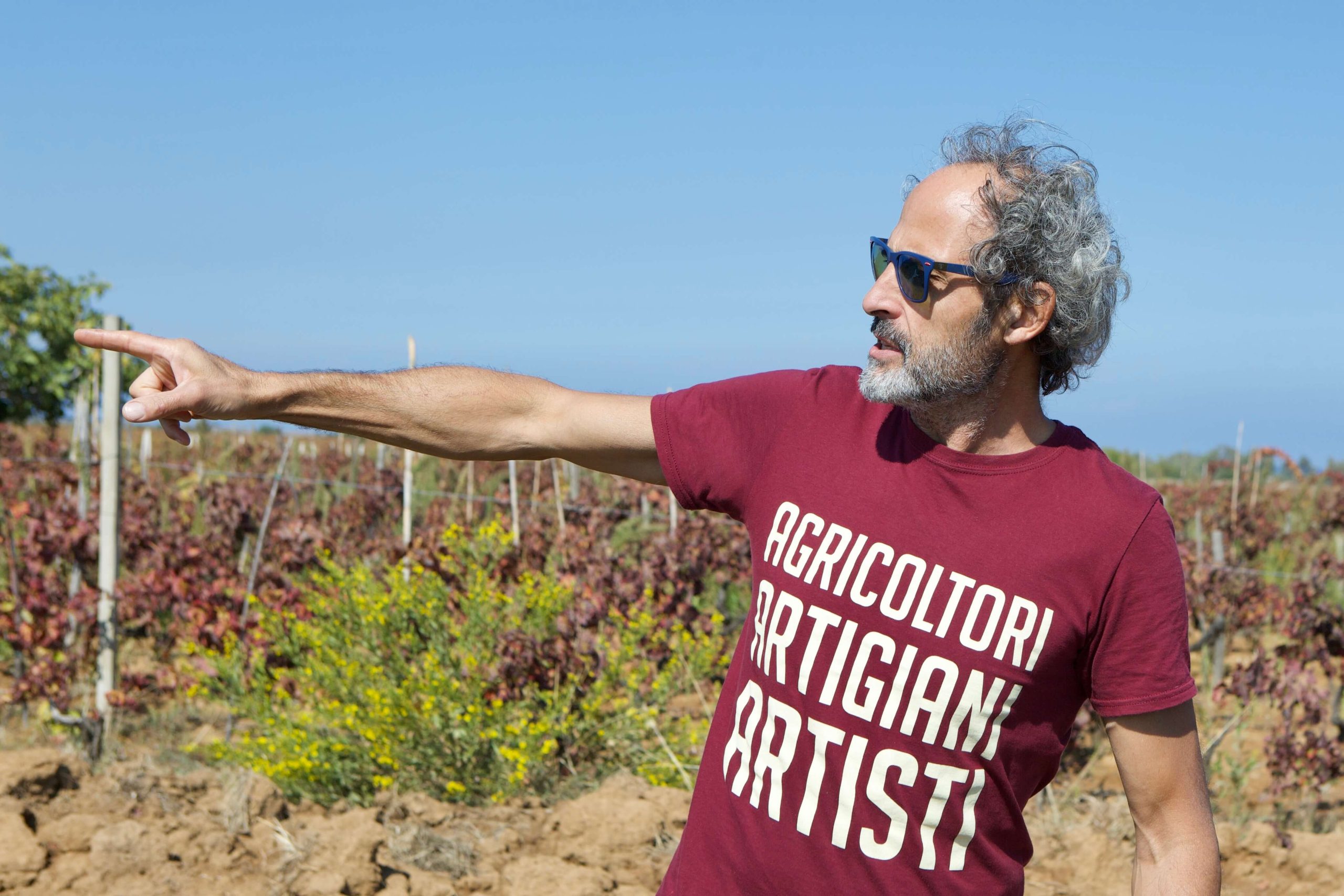
Sergio can be as stubborn as a Spartan, but I appreciate his unyielding conviction. It’s what makes his wines so special to start with. I also value that he allowed me to make the case for his own good and the greater good of Cirò by educating the wine public with a stand-alone Gaglioppo. For months, he resisted my request with periodic volleys of texts explaining why he shouldn’t do it. But, he did it. When I asked why he finally agreed to do it, he said, “Because you asked me to.”
Ah, Sergio …


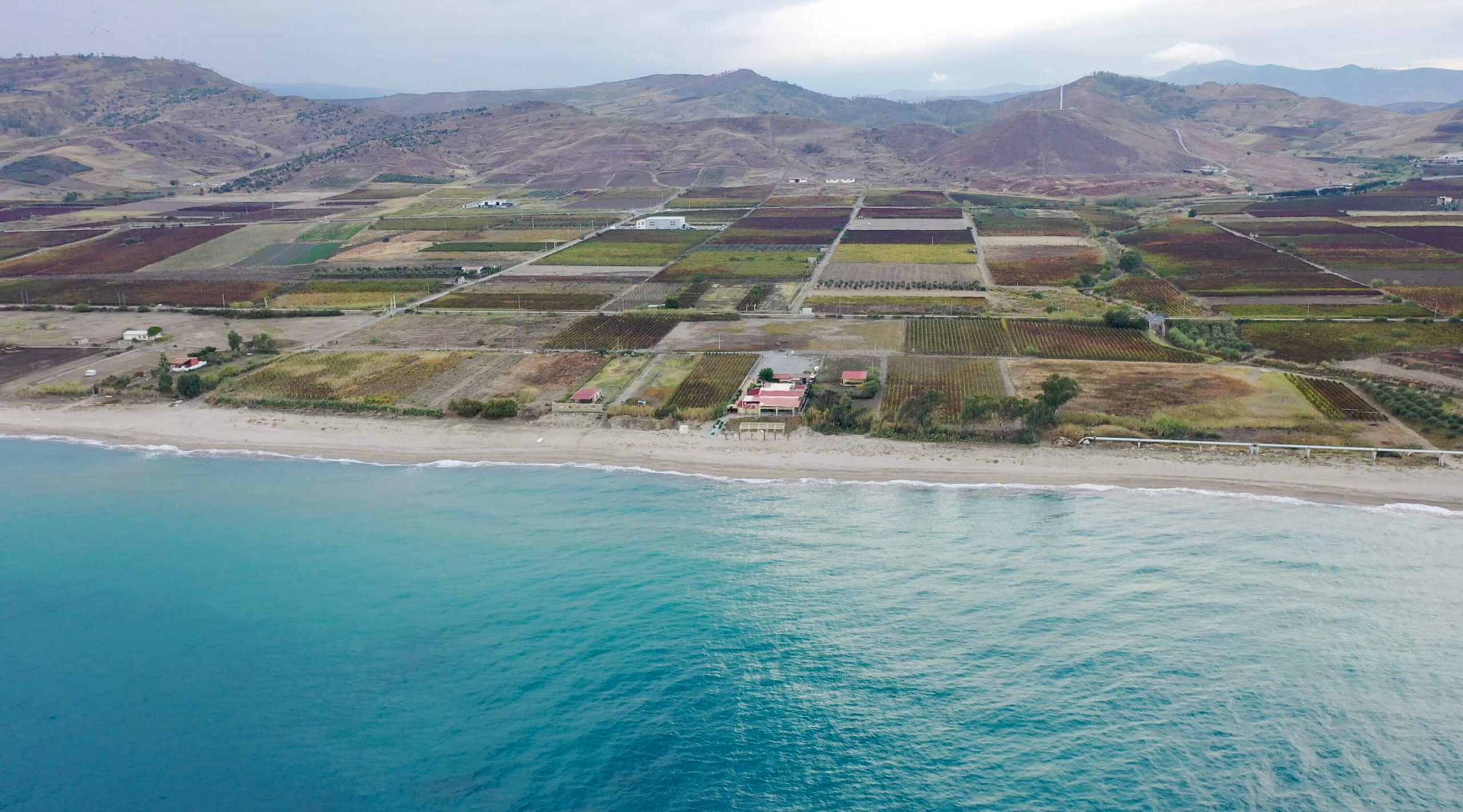
Sourced entirely from within the Cirò appellation’s southern end, facing directly east, where the clay is richer in calcareous materials than Cirò vineyards further north, the 2024 Gaglioppo Vino Rosso finally arrived in California in February or March. After a few months of rest, I asked our talented collaborator in southern California, Tyler, to taste a bottle, and he said, “… I was not expecting something so soft and delicious. We’ll have no issues finding homes for this wine …”
I tasted it four times throughout its process: one just after bottling in Piemonte with Dave Fletcher and Gino from Sette, and two about four and five months later, and the last at the end of April as I typed this newsletter. The second and last bottles were completely on point: a delicious, clear ruby red with those unmistakable Aperol notes of lightly bitter and sweet orange peel and orange blossoms, along with a slightly glycerol red licorice and spice—the fruit and flower profile in its youth is mirrored by the red sphere on the label. Known for serious structure, the tannins here are indeed tamed by a twelve-hour maceration for half the grapes and direct press for the other half. Raised in steel until the following summer, a touch of sulfites added only after malolactic and again at bottling, and lightly filtered just for turbidity, it has a precise voice of its grape and beachside terroir on calcareous clay.
This gentleness and aromatic pressure open the door for this wine to be one of those “chilled reds,” but, in all honesty, it would be a waste of its complexities to chill it too much. Treat it like any other red with a modest chill and get ready for some serious enjoyment backed with an inimitable distinction of place. Bravo, Sergio! Ancora!
Ancora …
That third bottle opened sometime in February and sat in my kitchen at around 60°F for at least five days after I tasted it over a three-day period—half full, unmoved from the counter for two full days, where I left it, uncorked. I had just finished two days of tasting a new Portuguese grower for us, Herdade de Cebolal. Located ten miles from the Atlantic, and crafting some of the most charming low-alcohol, fresh, salty and iodiney whites and fruit-pure and compelling light reds (palhete and clarete) at killer prices from organic and regeneratively farmed polyculture land, I’ve tried to land Cebolal for almost five years. I regretfully dumped the rest of the Cebolal wines, even though they were still in top form, because I had another big batch of wines to taste in the coming days. As I dumped them, I could feel the Gaglioppo sitting there behind me, like Pennywise in the shadows late at night. At risk of damaging my confidence in what I’d proven out over three days as totally stable and relentlessly delicious, I thought, what the hell? I’ll give it a whirl five days after opening it and after tasting a massively charming set of wines from Cebolal–a tough follow for any wine after five days open. I gave the bottle a quick tip into the sink to sparge this suffocating wine with some fresh air five minutes before pouring it into my glass. (I’ve found that wines need this if they’ve been sitting around—same concept as racking a stagnant wine in the cellar, only here it’s on a micro level. Somehow, it works better this way than just pouring it straight into the glass. Rejuvenation.) The wine was absolutely bulletproof. Shockingly so, in fact. In incredible form and perhaps even purer than those first days open, this was an excellent sign.
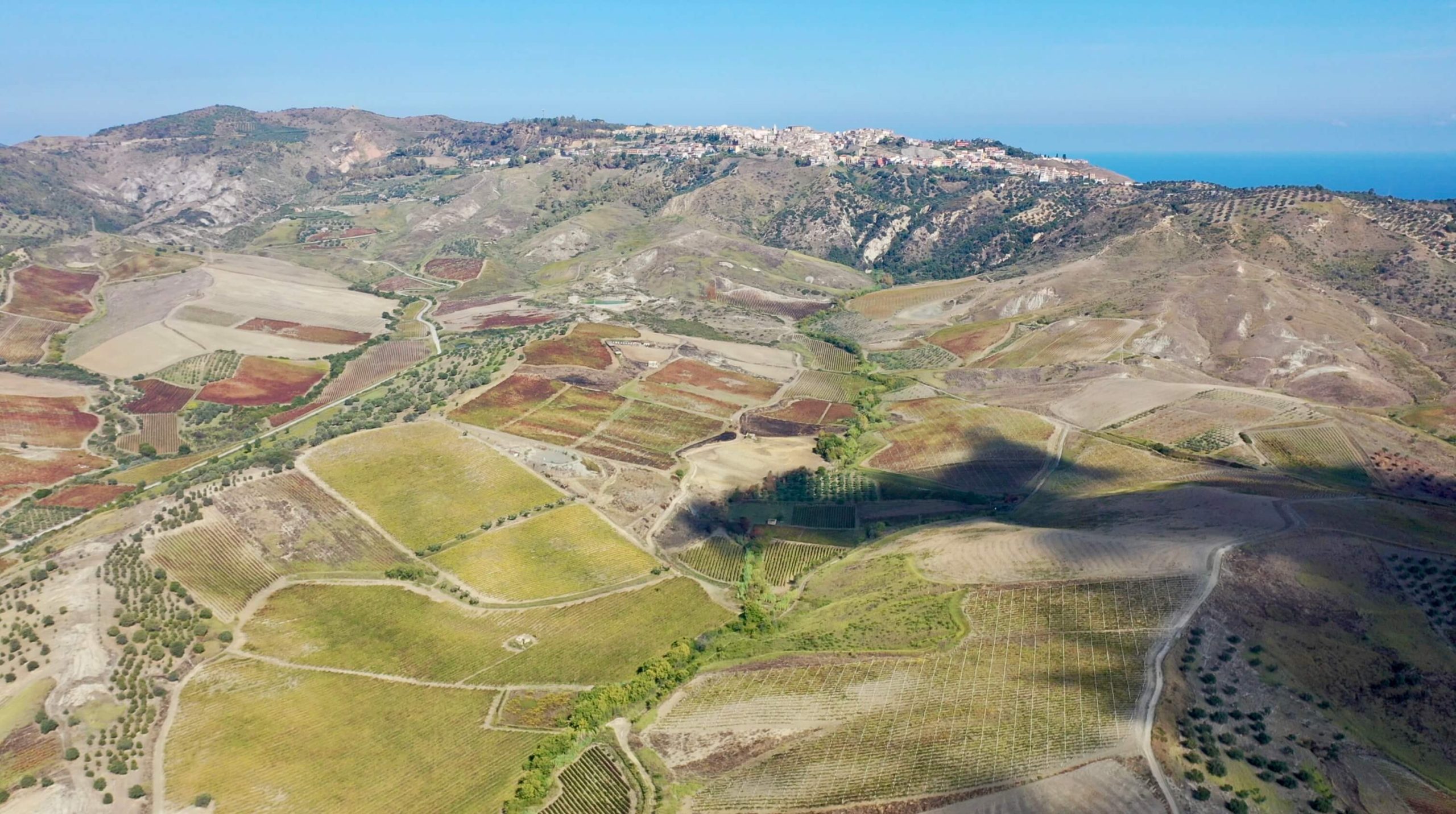
Even when intended for a short life, Gaglioppo, at least under Sergio’s guidance, seems determined to live 3,000 years. Smitten yet again, and with an even greater conviction for this world-class grape adapted to this world-class terroir longer than probably any grape to terroir in all of Italy.
With this new wine made in such a simple and quick turnaround, and Sergio’s Aris Riserva and Piu Vite Riserva Cirò wines, and even his rosato of Gaglioppo, I remain convinced that this grape is the missing big story within the truly noble red varieties that start in Sicily and wind their way up the boot all the way to Piemonte.
